Tag: USB Hubs

Best USB Hubs for Connecting Multiple Devices

Look for a mix of 4‑port travel hubs and switches for power users. For travel, try the UGREEN 4‑Port Ultra‑Slim, Acer 4‑Port with a 2‑ft cable, or Anker 4‑Port; they’re plug‑and‑play and reach USB 3.0 speeds up to 5 Gbps. For setups, consider the ONFINIO 7‑Port with individual switches or the Sabrent 4‑Port with per‑port LEDs. If you need serious charging, the 200W GaN III 8‑Port hub handles eight devices at once. More options await.

Key Takeaways

  • For expanding many peripherals, a 7-port hub with individual on/off switches provides per-port control and space for keyboards, drives, and more.
  • For portable setups, choose a compact travel hub like a 4-port USB-C/USB-A 3.0 model.
  • If you need real power, the 200W GaN III 8-Port USB-C charger hub can run eight devices at once.
  • For fast, driver-free expansion on desktops and laptops, use standard USB 3.0 hubs offering up to 5Gbps and multiple ports.
  • Ultra-slim hubs are ideal for laptops or consoles, delivering plug-and-play expansion in a compact form factor.

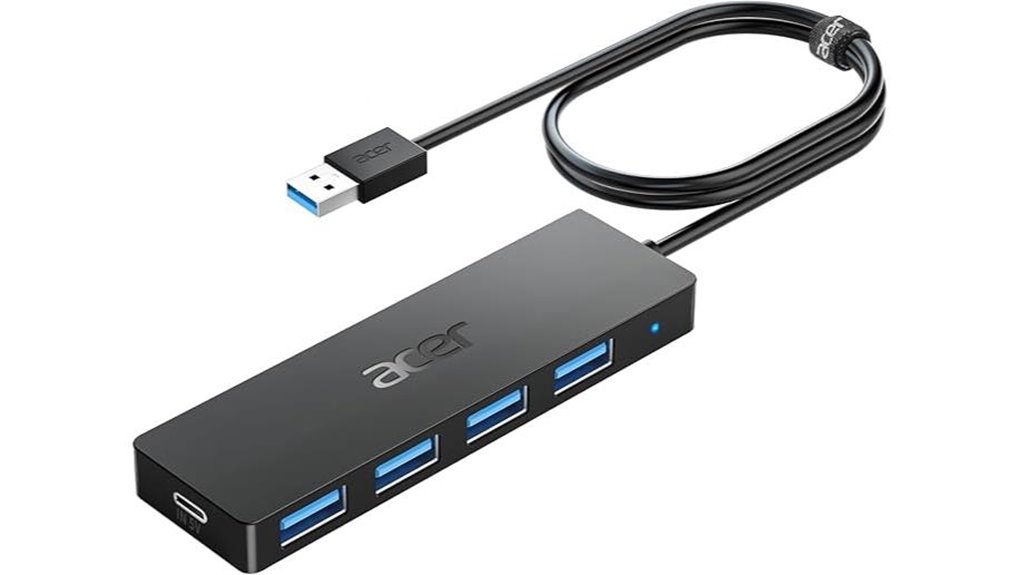
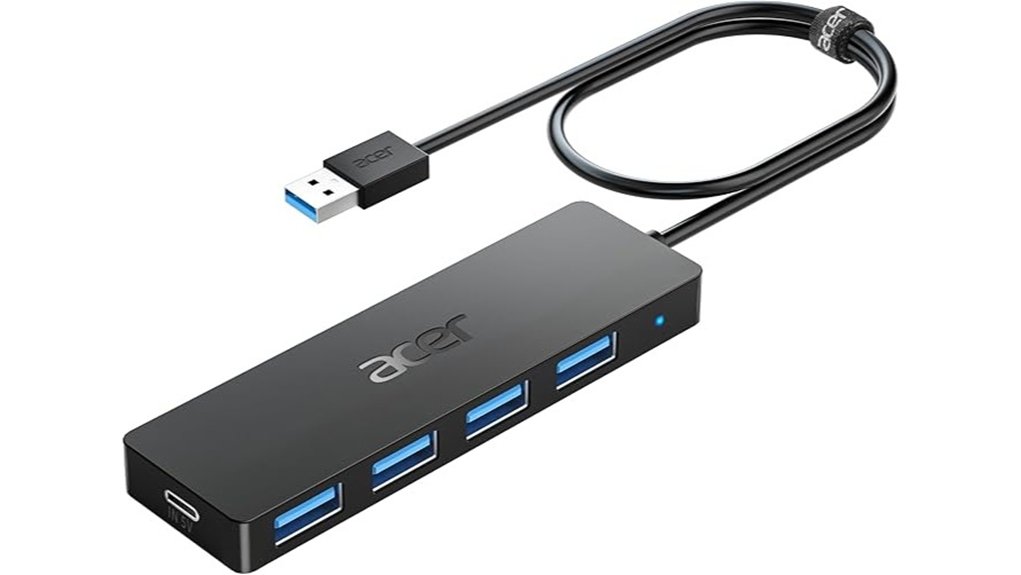
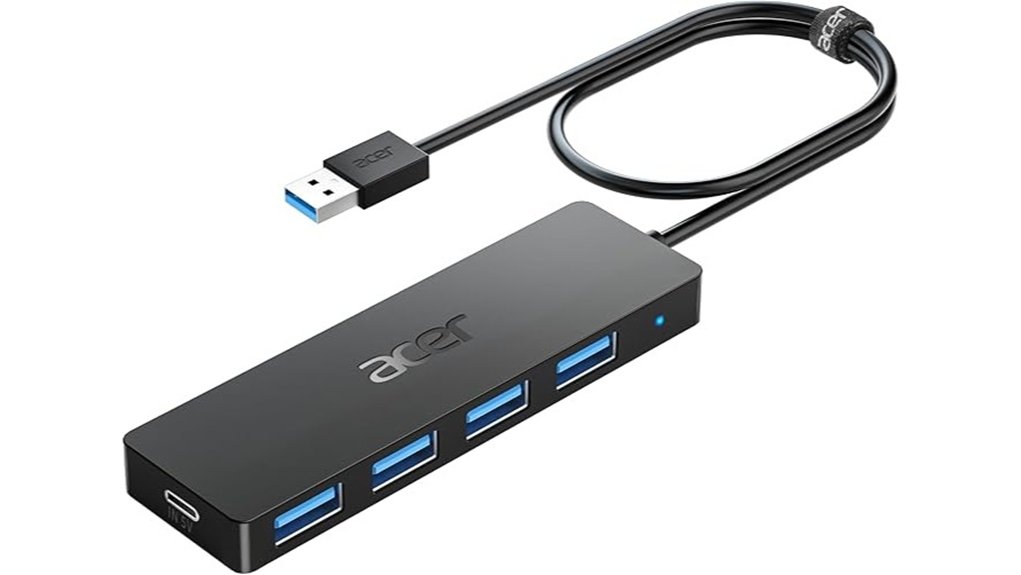
Acer 4-Port USB 3.0 Hub with 2ft Cable
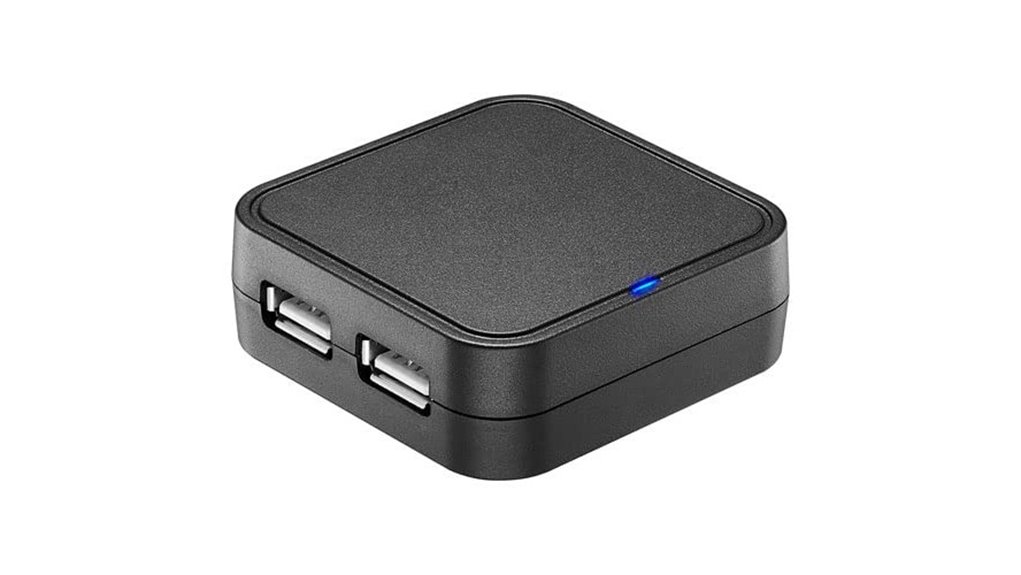
acer 4 port usb 3 hub

Best for on‑the‑go users who need four high‑speed USB 3.0 ports from a slim, driver‑free hub. You get four USB 3.0 ports at up to 5Gbps, wrapped in a 2ft cable, model ACER-UH501 in black. It weighs 1.6 oz and measures 4.13 x 1.18 x 0.35 in, with a durable housing and enhanced heat dissipation. Plug‑and‑play keeps you moving without drivers. The LED indicates status while all four ports can run simultaneously. Note: HDDs need the 5V USB-C power port for stable data; the USB-C input can’t transfer data or charge. You can use it with laptops, desktops, rigs.

Best For: On-the-go users who need four high-speed USB 3.0 ports from a slim, driver-free hub.

Pros:

  • Four USB 3.0 ports with up to 5Gbps data transfer in a single, plug-and-play hub
  • Slim, portable, lightweight design with a 2ft cable and durable housing
  • LED status indicator and support for all four ports operating simultaneously

Cons:

  • USB-C input is power-only; it cannot transfer data or charge devices
  • HDDs require the 5V USB-C power port for stable data; without it, data stability may suffer
  • Real-world speeds may vary due to host bandwidth and four-port sharing

https://www.amazon.com/dp/B0CN3F9Y1Z

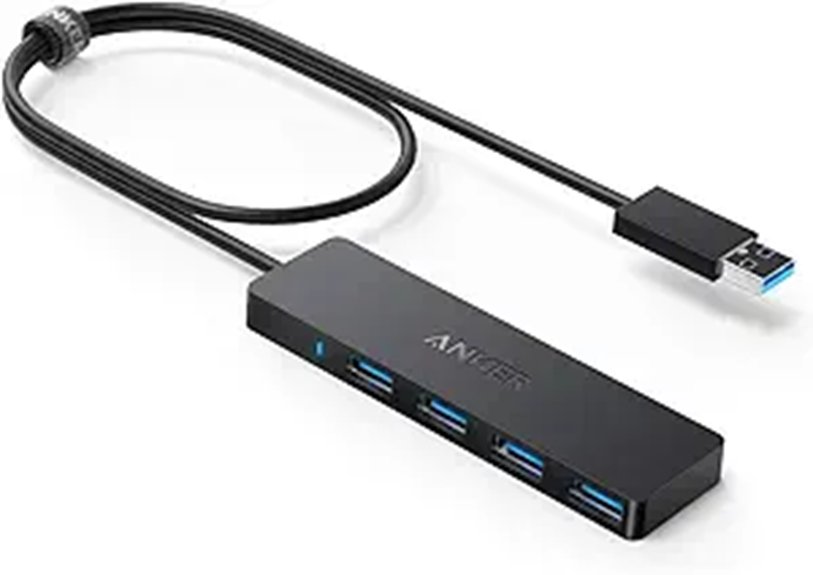
Anker 4-Port USB 3.0 Hub for Laptop
anker 4 port usb3 0 hub

This 4-port USB 3.0 hub is ideal for laptop users who need to add multiple USB-A connections without adding bulk. You get four ports from USB-A input, with USB 3.0 up to 5Gbps for HD movie transfers.

Charging isn’t supported, so you stay in control. It weighs 1.76 ounces and measures 27.68 x 1.18 x 0.39 inches, keeping your setup tidy. AK-A7516012 includes a 2ft USB-A cable, the slim data hub, a welcome guide, and an 18-month warranty with support. Trusted by 80 million+ users and sits at #2 in USB Hubs with a 4.7/5 rating from 135,885 reviews.

Best For: Laptop users who need extra USB-A ports without bulk, want USB 3.0 speeds up to 5Gbps, and don’t require power charging.

Pros:

  • Expands a single USB-A port into four USB 3.0 ports with speeds up to 5Gbps.
  • Ultra-portable and slim: weighs 1.76 oz and compact 27.68 x 1.18 x 0.39 inches.
  • Includes a 2ft USB-A cable and comes with an 18-month warranty and reliable support.

Cons:

  • Not designed to charge devices; power comes from the host.
  • Short 2ft cable may limit placement in larger setups.
  • Bandwidth is shared across four ports, which can affect performance with multiple high-speed devices.

https://www.amazon.com/dp/B07L32B9C2

ONFINIO 7-Port USB 3.0 Hub with Switches
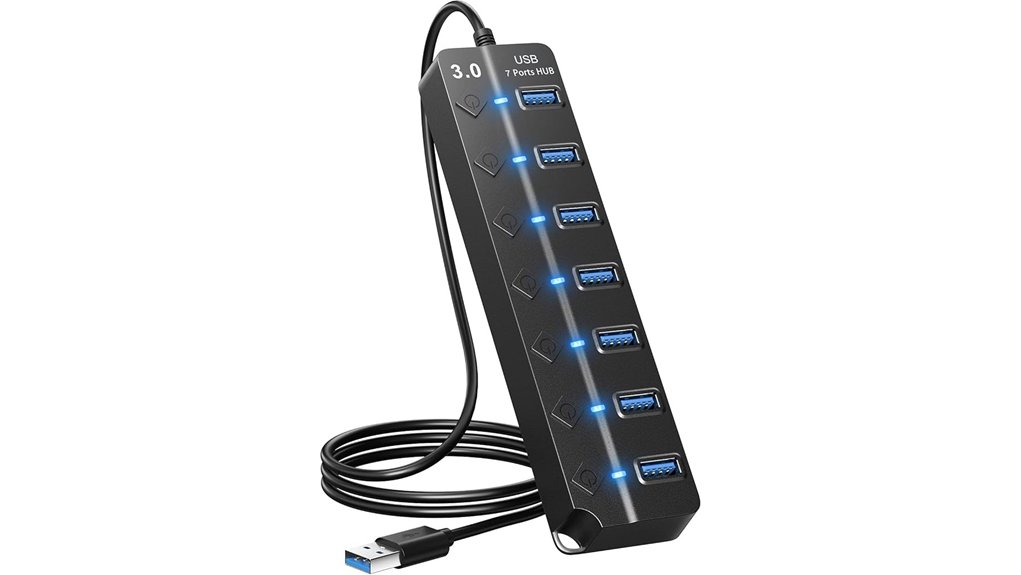
onfinio 7 port usb hub

Anyone juggling multiple peripherals will appreciate the ONFINIO 7-Port USB 3.0 Hub with Switches, which gives you independent on/off switches on every port for precise control and easy energy management. With seven USB 3.0 ports and independent on/off switches, you control power to every device without unplugging. The compact, portable hub stays out of the way while you’re expanding your setup.

You get speeds up to 5Gbps, and USB 2.0/1.0 compatibility. 3.2 ft cable keeps it reachable; each port has indicator lights visible. Plug-and-play, hot-swapping supported; external power helps devices. OS compatibility spans Windows, Mac, Linux, and Chrome OS.

Best For: Users who need independent on/off control for multiple USB peripherals in a compact 7-port hub with energy management.

Pros:

  • Independent on/off switches for every port enable precise power control and easy energy management.
  • Seven USB 3.0 ports with up to 5Gbps speeds, plus plug-and-play and hot-swapping.
  • Backward compatible with USB 2.0/1.0 and supports external power for power-hungry devices.

Cons:

  • External power supply is recommended for high-power devices; without it, some devices may not function reliably.
  • No USB-C port; uses USB-A 3.0, which may limit compatibility with newer devices.
  • Seven switches and LEDs can add bulk and may wear with frequent use.

https://www.amazon.com/dp/B0B6B1J4ZT

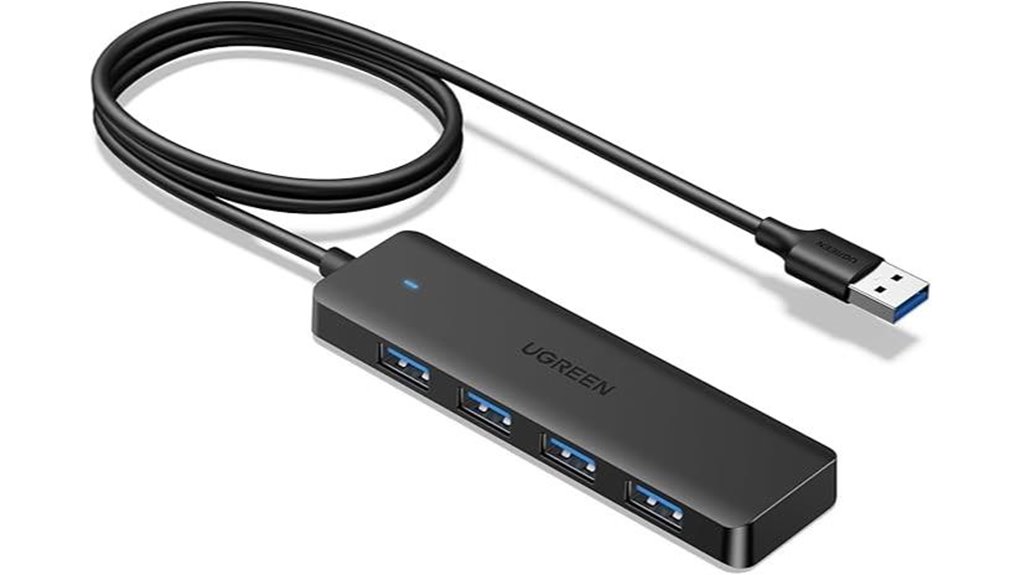
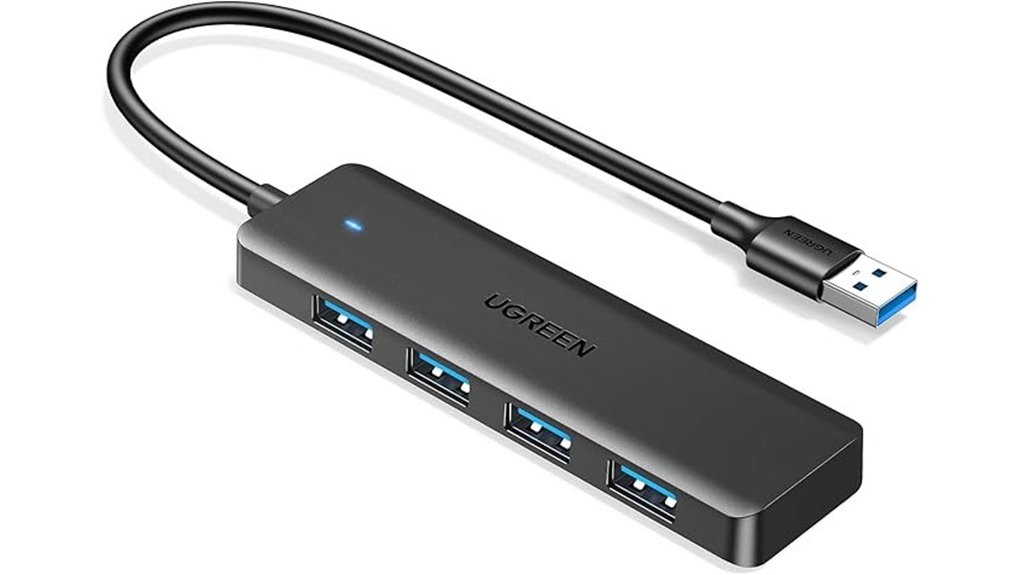
UGREEN USB 3.0 Hub 4-Port Ultra-Slim
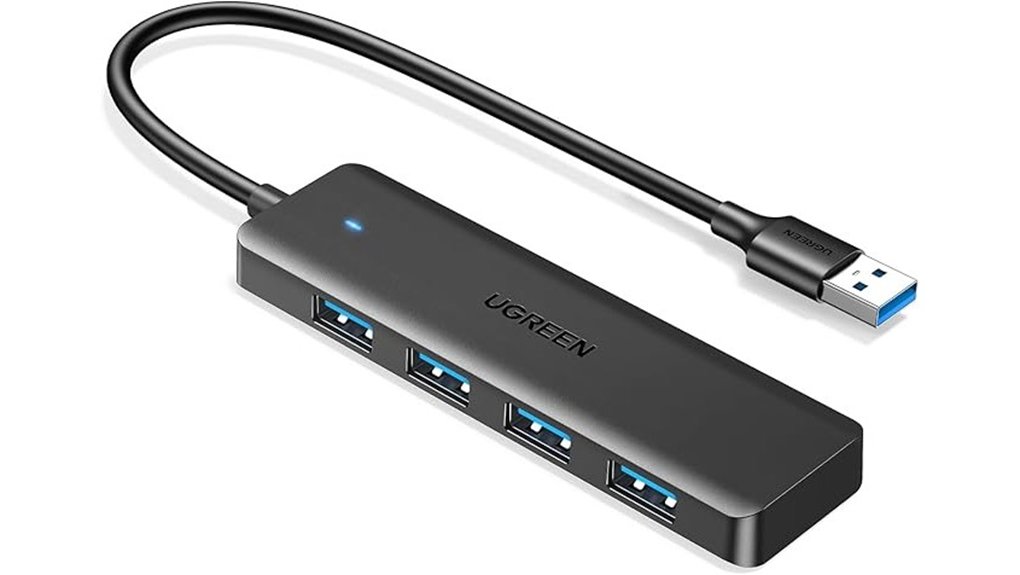
ugreen usb 3 0 hub

If you need to add four USB-A ports to a laptop or console on the go, the UGREEN USB 3.0 Hub 4-Port Ultra-Slim is a compact, plug‑and‑play solution. Ultra-slim at 0.4 in thick and weighing 33 g, it comes in black as model 25851 and works with laptops, desktop PCs, Xbox Series, PS5, and other devices.

With USB 3.0, you reach up to 5 Gbps and a 10 GB transfer in 16.4 seconds. It expands USB-A port to four, plug‑and‑play with no drivers, and works with Windows, macOS, Linux, and Chrome OS. Use it for mice, keyboards, and drives.

Best For: Travelers and gamers who need extra USB-A ports on laptops or consoles while on the go.

Pros:

  • Ultra-slim and lightweight design (0.4 in thick, 33 g) for easy portability.
  • USB 3.0 speeds up to 5 Gbps, with a 10 GB transfer in about 16.4 seconds.
  • Plug-and-play with no drivers and expands to four USB-A ports from a single USB-A host port.

Cons:

  • Only USB-A ports; no USB-C or dedicated charging port.
  • Bandwidth is shared across all four ports, so performance can vary when multiple devices are connected.
  • Real-world speeds can vary and depend on the host USB port and connected devices.

https://www.amazon.com/dp/B0CD1BHXPZ

4-Port USB Hub USB-C and USB-A 3.0
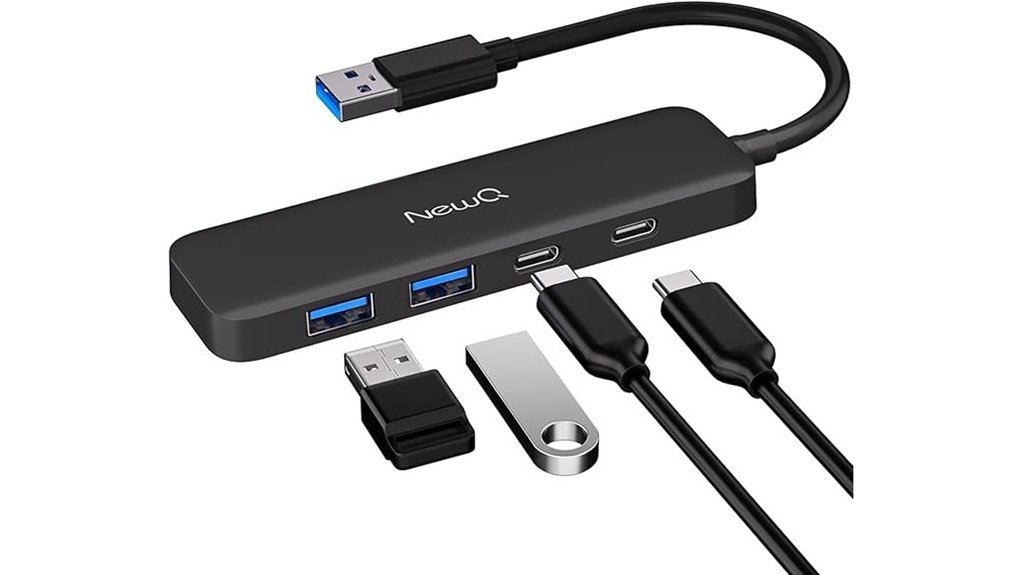
four port usb c usb a hub

A compact 4-port USB-C and USB-A 3.0 hub is ideal for travelers, students, or anyone who needs fast, simultaneous USB expansion from a single portable device. It lets you use two USB-C 3.0 ports and two USB-A 3.0 ports, four ports total, that all run at 5Gbps and deliver USB 3.0 bandwidth. USB-C ports boost compatibility; no USB-A-to-C adapter needed.

PD charging and display output aren’t supported. It’s ultra-slim, plug-and-play; no drivers. OS compatibility includes Windows, macOS, Linux, Chrome OS. Use it with laptop, PS4, drive, Xbox, printer, mouse, or keyboard. 4.1 x 1.14 x 0.35 inches; 1.41 ounces.

Best For: Travelers and students who need a compact, plug-and-play 4-port USB-C/USB-A 3.0 hub to expand laptop or console USB with fast 5Gbps bandwidth.

Pros:

  • Ultra-slim, portable design ideal for travel and on-the-go use.
  • Four ports (2 USB-C 3.0, 2 USB-A 3.0) with up to 5Gbps total bandwidth; no drivers required.
  • Broad OS compatibility and plug-and-play with no driver installation.

Cons:

  • No PD charging (power delivery) support; cannot charge devices through the hub.
  • No display output or monitor support.
  • Performance depends on the host USB port and may share bandwidth across all ports.

https://www.amazon.com/dp/B0BRPWN5F6

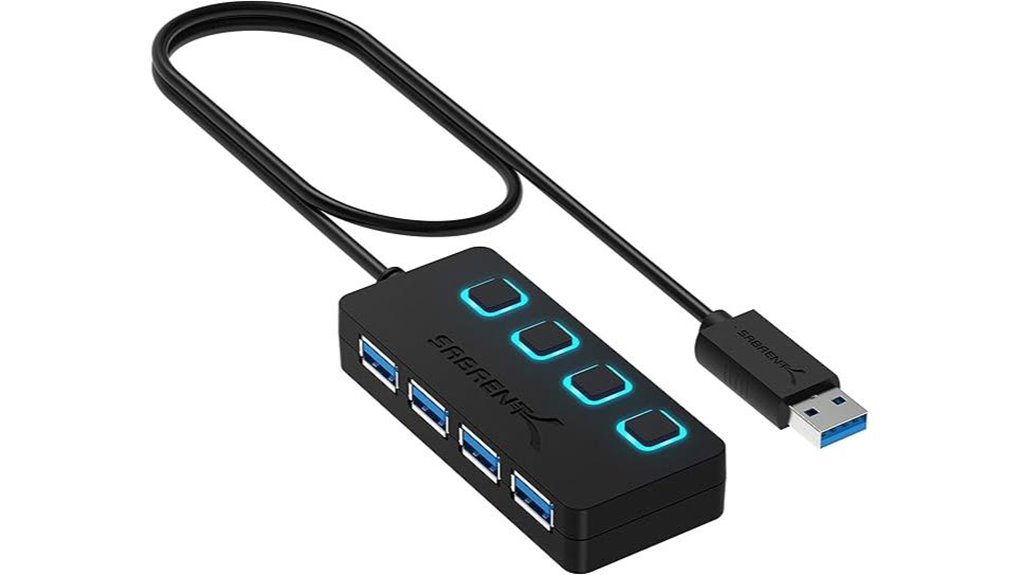
Sabrent 4-Port USB 3.0 Hub with LEDs
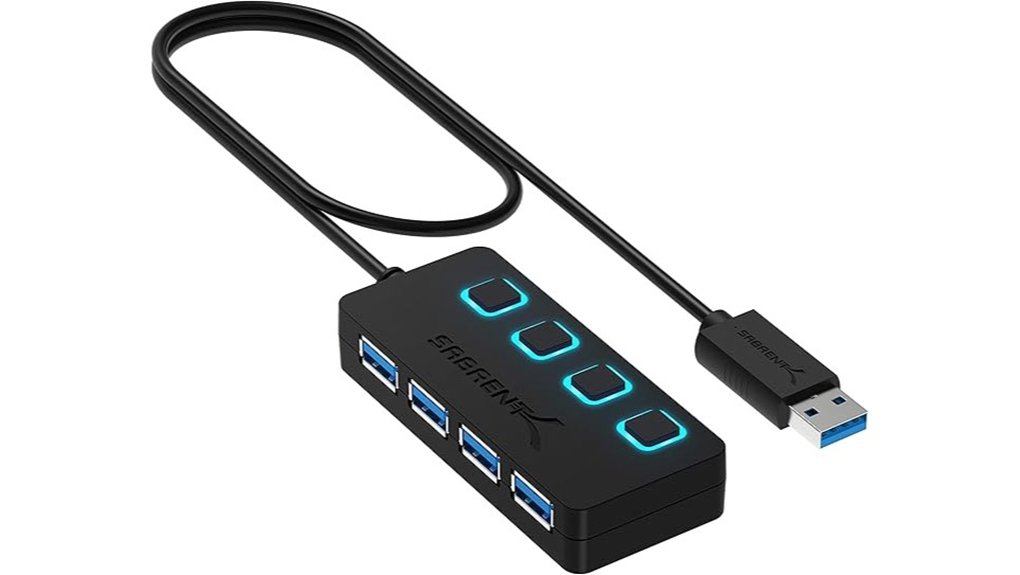
sabrent four port usb 3 0 leds

For on-the-go users who want precise control over connected devices, the Sabrent 4-Port USB 3.0 Hub with LEDs is ideal: four USB 3.0 ports in a slim, portable shell, each with its own LED indicator and power switch. A 2 ft cable provides flexible placement, and the hub’s plug & play.

Performance reaches up to 5 Gbps on USB 3.0, compatible with USB 1.1, 2.0, and USB drives, PCs, Macs, Linux systems. Not charging, but individual port switches let you disconnect devices as needed; LEDs clearly show activity. Setup requires no drivers, and 2 ft cable offers flexible placement.

Best For: On-the-go users who need compact USB 3.0 expansion with per-port power switches and LEDs for precise device control.

Pros:

  • Per-port power switches for easy disconnect and control
  • Individual LED indicators and USB 3.0 speeds up to 5 Gbps
  • Slim, portable design with a 2 ft cable and plug-and-play setup

Cons:

  • Not a charging hub; cannot charge devices through the hub
  • Only four ports, which may be limiting for many peripherals
  • Placement may be limited by the fixed 2 ft cable length

https://www.amazon.com/dp/B00JX1ZS5O

200W GaN III 8-Port USB-C Charger Hub
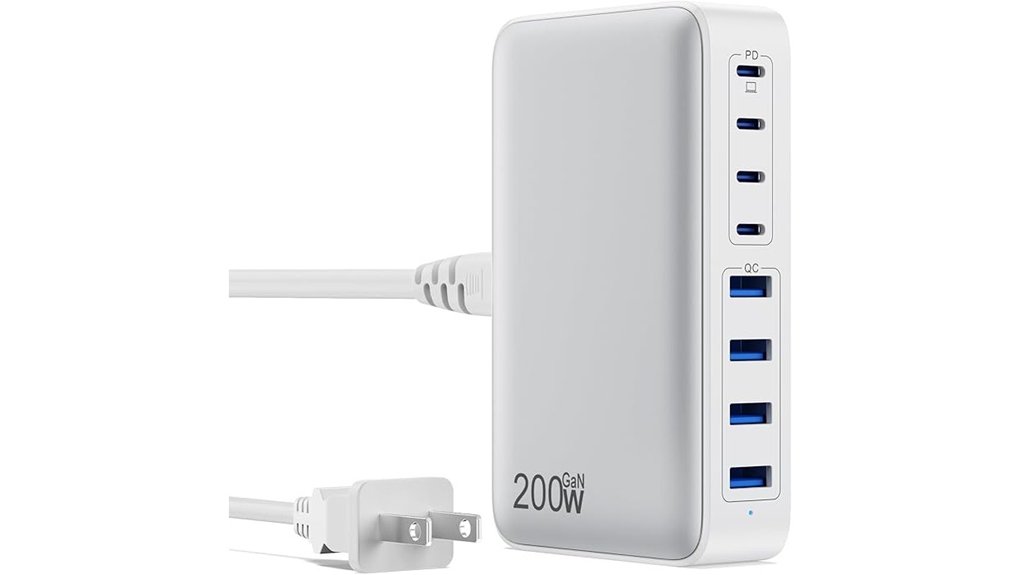
200w gan iii usb c hub

Power users who need eight devices charging simultaneously without slowing any port you’ll appreciate this GaN III 8-Port USB-C Charger Hub, delivering full-speed performance on every connection. Independent ports deliver eight outputs: 4 USB-C, 4 USB-A, so you can charge eight devices simultaneously with no power sharing, preserving full-speed per port. Your desk stays organized, reducing the need for extra accessories. GaN III tech powers the hub with a chipset and built-in multi-protection, boosting energy efficiency, improving heat dissipation, and keeping your unit small and radiation resistant.

65W and 30W ports power; MacBook Pro 55% in 30 minutes today.

Best For: Power users who need eight devices charging simultaneously with independent, full-speed ports and a compact GaN III hub for desks, home offices, or travel.

Pros:

  • Independent eight ports with no power sharing deliver full-speed per port, allowing eight devices to charge simultaneously.
  • GaN III technology with multi-protection delivers higher efficiency, better heat dissipation, and a smaller, safer, radiation-resistant design.
  • 65W and 30W USB-C PD ports enable fast charging for laptops and devices, with broad compatibility across MacBook Pro/Air, Dell XPS, iPhone, Samsung Galaxy, iPad, Steam Deck, and more.

Cons:

  • Only two USB-C PD ports (one 65W and one 30W) may limit fast charging for multiple high-power devices at once.
  • If all eight ports draw near their max, the total 200W budget could reduce per-port speeds in real-world high-load scenarios.
  • Desk setup can become cluttered due to eight ports and the hub’s cabling; may require mindful cable management.

https://www.amazon.com/dp/B0CQYJVJDR

Upoy 5-Port 40W USB Charging Station
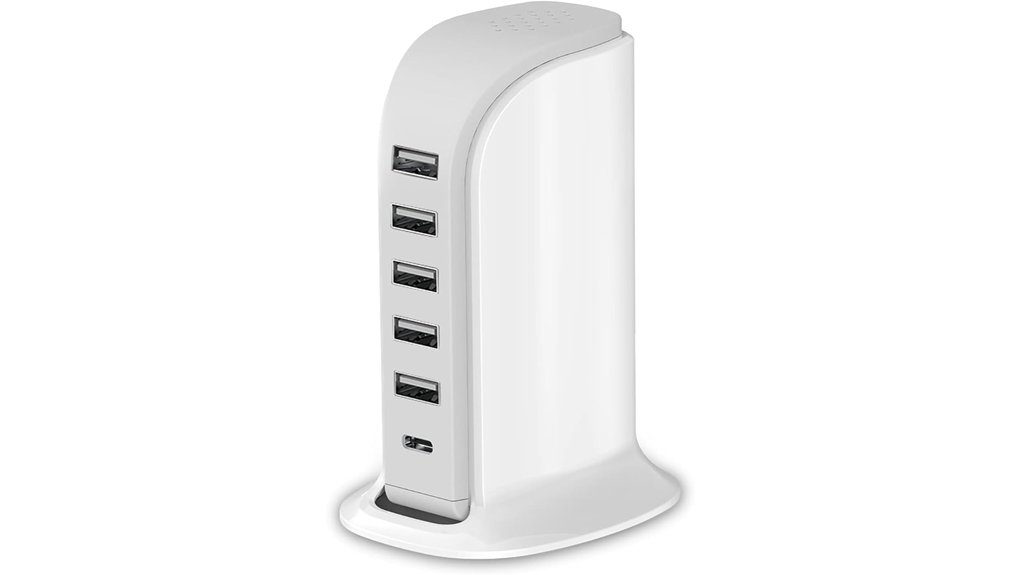
upoy five port usb station

This compact desktop charging hub is ideal for home offices or boats where you need to power multiple devices without clutter. The Upoy 5-Port 40W station features a sailboat-inspired, compact shell built with a hot runner process and 1382°F anti-combustion protection, delivering heat dissipation and space-saving design.

Power and ports: 40W total, six devices for you. A port to 2.4A; Type-C 3A. IC and Smart Flow tailor current per device, with protections for over voltage, over current, over temperature, over charge, short circuit, and disconnect. Dimensions are 3.11 by 1.77 by 4.4 inches, it’s 7.5 ounces; iPhone, iPad, tablets.

Best For: Compact, space-saving charging hub ideal for home offices or boats that need to power multiple devices without clutter.

Pros:

  • Space-saving, sailboat-inspired design with heat dissipation and 1382°F anti-combustion protection for safe desk or boat use.
  • Smart IC/Smart Flow optimizes current per device, with per-port up to 2.4A (and Type-C 3A) to charge a variety of devices safely.
  • 40W total output supports multiple devices simultaneously (up to six), with broad compatibility for iPhone, iPad, tablets, and smartphones.

Cons:

  • 40W total may limit charging speed when several high-demand devices are connected.
  • Per-port current limits (2.4A standard, 3A on Type-C) may not meet the fastest charging needs of some devices.
  • Some spec details appear inconsistent (5-Port design vs. claims of six devices), which could cause confusion about actual port count and throughput.

https://www.amazon.com/dp/B08R73ZJ6P

PANPEO 7-Port USB 3.0 Hub with LED
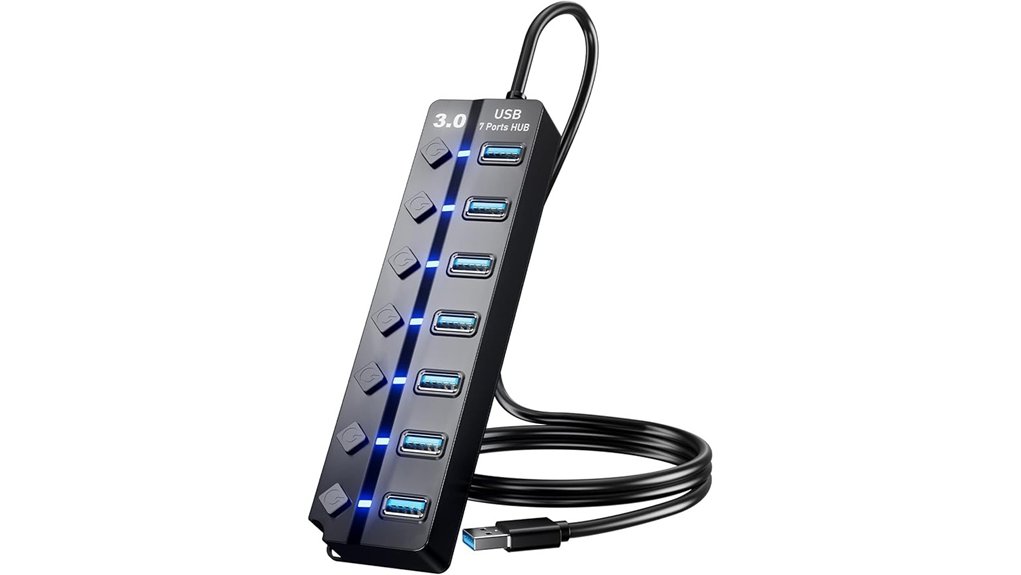
panpeo 7 port usb hub

Ideal for students and remote workers who need to expand a laptop’s USB, the PANPEO 7-Port USB 3.0 Hub with LED adds seven fast ports and per-port LED indicators. With a 3ft built-in cable, it’s plug‑and‑play, lightweight, and travel‑ready for home, office, or school. It transfers data up to 5 Gbps, is backward compatible with USB 2.0/1.0, and does not support charging, so you power peripherals from your device. Use it with laptops, PCs, Surface Pros, PS4/5, flash drives, keyboards, mice, HDDs, and printers. LEDs are independently controllable to show activity per port. Compact enough for desks and bags.

Best For: Students and remote workers who need to expand a laptop’s USB ports for added versatility and per-port activity indicators.

Pros:

  • Seven USB 3.0 ports with up to 5 Gbps total throughput and independent per-port LEDs.
  • Plug-and-play, lightweight design with a built-in 3-foot cable, ideal for travel and on-the-go setups.
  • Backward compatible with USB 2.0/1.0 and does not require external power for typical peripherals.

Cons:

  • Does not support charging; relies on the host device to power connected peripherals.
  • May not provide enough power for high-power devices like certain external HDDs or printers without a powered hub.
  • Built-in 3-foot cable may be too short for some desktop or hard-to-reach setups.

https://www.amazon.com/dp/B0BZPFRGPN

VIENON 4-Port USB 3.0 Hub Rotatable PD-in
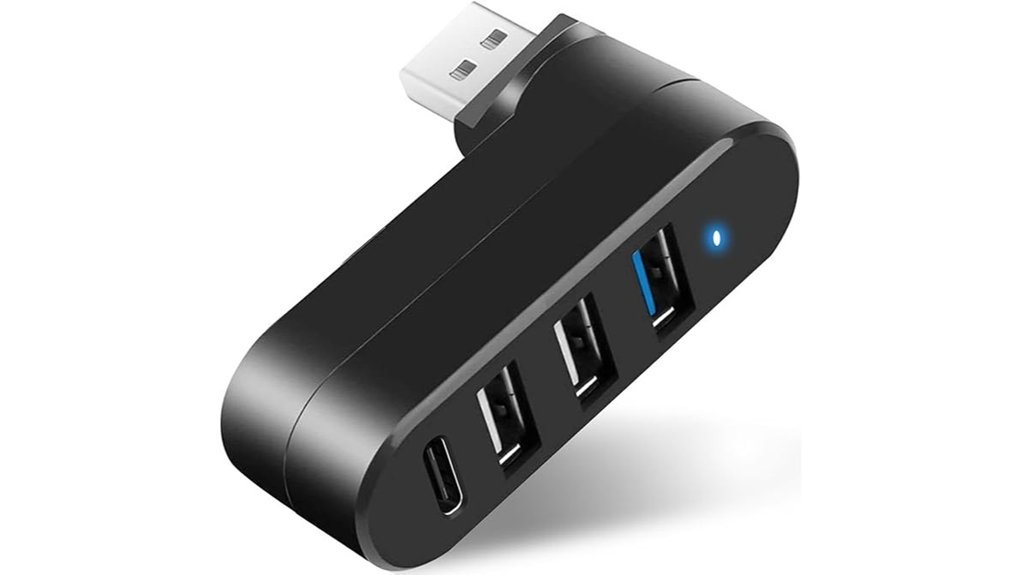
vienon 4 port usb 3 0 hub

For Mac laptops and in-car setups that need extra USB ports, the VIENON 4-Port USB 3.0 Hub Rotatable PD-in offers a rotatable 90°/180° body with a USB-C PD-in power input. Four ports give you one USB 3.0, two USB 2.0, and a USB-C female port. You get USB 3.0 up to 5 Gbps, while USB 2.0 runs at 480 Mbps for Mac mini. It’s plug-and-play, you won’t need drivers, and it works with Windows, macOS, and Linux; you won’t charge devices. You can use Mac Pro, iMac, MacBook Air, MacBook Pro; it suits Tesla Model Y and Model 3.

Best For: MacBook users and in-car setups that need extra USB ports, with a rotatable hub and USB-C PD-in power input.

Pros:

  • Rotatable design for flexible placement in desks or cars.
  • USB-C PD-in powers the hub without requiring a separate charger.
  • Plug-and-play with driver-free operation on Windows, macOS, and Linux.

Cons:

  • No charging output to connected devices; power input only.
  • Only one USB 3.0 port; the other ports are USB 2.0, which can bottleneck faster peripherals.
  • Not suitable for audio/video transfer or sound devices.

https://www.amazon.com/dp/B0CRYWK9DB

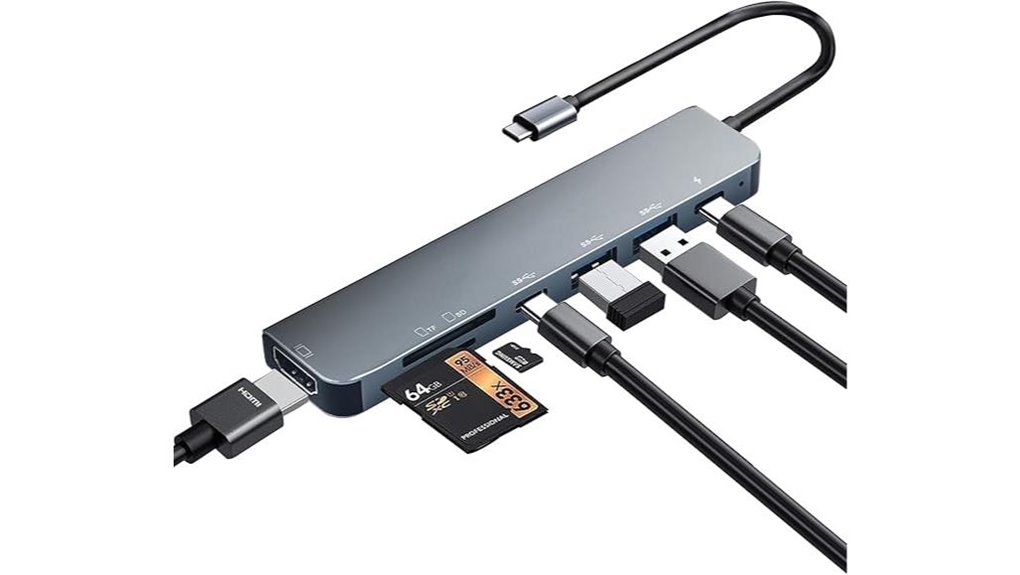
BERLAT Aluminum USB-C 7-in-1 Hub with USB 3.0/2.0
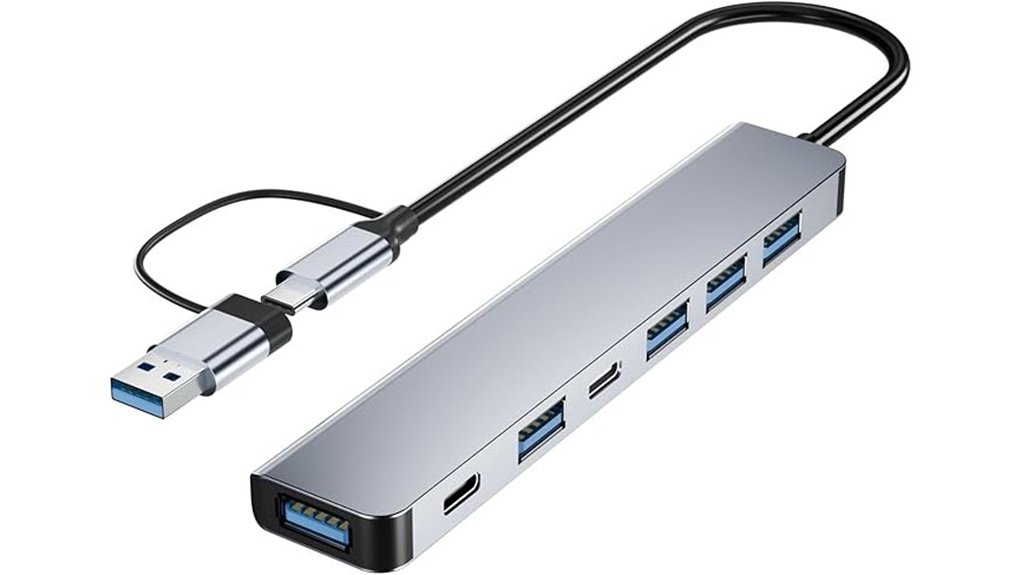
berlat aluminum usb c 7 in 1

If you need a compact, all-in-one USB-C hub to power multiple devices from a single laptop, the BERLAT 7-in-1 delivers fast data and broad compatibility in a slim aluminum chassis. It gives you 1 USB 3.0 port, 4 USB 2.0 ports, USB-C 2.0 ports, with 5 Gbps on USB 3.0. Use it to move videos, music, photos, and files, with broad OS support from MacBook Pro/Air to Windows, Android, Chrome OS, and Linux everywhere today. You’ll notice its aluminum body, measuring 4 by 1 by 0.5 inches, weighing 1.41 ounces, and matching with laptops, PC towers, Xbox, and PS4.

Best For: Travelers and professionals who need a compact, all-in-one USB-C hub to expand a laptop’s connectivity and transfer media quickly.

Pros:

  • Ultra-compact aluminum body that’s portable
  • 7-in-1 setup with 1× USB 3.0, 4× USB 2.0, and 2× USB-C 2.0 for broad device support
  • High-speed data transfer on USB 3.0 up to 5 Gbps and broad OS compatibility

Cons:

  • Only one USB 3.0 port; the rest are USB 2.0 or USB-C 2.0, limiting high-speed transfers
  • USB 2.0 performance for most devices may bottleneck large file transfers
  • No built-in video outputs (HDMI/DisplayPort) or Ethernet, so it isn’t a full docking station

https://www.amazon.com/dp/B0DBTFLPJP

VIENON Aluminum USB-C Hub 7-in-1 with USB 3.0
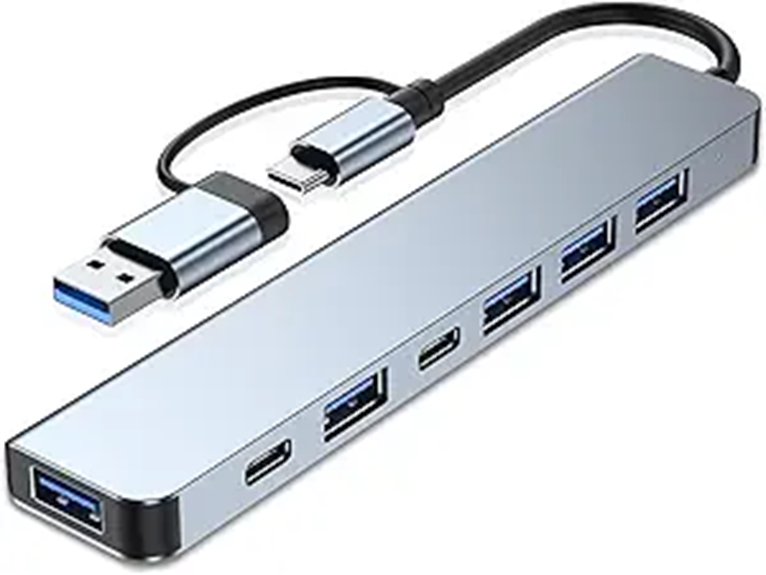
vienon aluminum usb c 7 in 1

This 7-in-1 USB-C hub is a smart choice for USB-C laptops that need fast data transfers and multiple peripheral options in one compact package. You get a mix of ports: 1 USB 3.0, 4 USB 2.0, and 2 USB-C 2.0, plus dual plug compatibility for MacBook Pro, MacBook Air, iMac, PS4 Pro, Surface Pro, PC, and other laptops. It supports simultaneous connections, with USB 3.0 data speeds up to 5 Gbps and USB 2.0 up to 480 Mbps, so transfers stay smooth while you’re multitasking.

Aluminum shell delivers durability and fast heat dissipation; cables stay flexible and reliable overall.

Best For: USB-C laptop users who want a compact, durable 7-in-1 hub to expand peripherals with fast USB 3.0 transfers and broad compatibility.

Pros:

  • USB 3.0 port delivers data speeds up to 5 Gbps for fast transfers while multitasking.
  • Broad compatibility across Mac, Windows, Android, and other systems with dual plug support for multiple devices.
  • Durable aluminum alloy shell with good heat dissipation and flexible, reliable cables.

Cons:

  • Most ports are USB 2.0, with only one USB 3.0 port, which limits high-speed performance for some peripherals.
  • No HDMI/video output or built-in card reader; limited to USB peripherals only.
  • USB-C 2.0 ports are slower than newer USB-C standards, reducing potential performance on some devices.

https://www.amazon.com/dp/B0C9D6PDMT

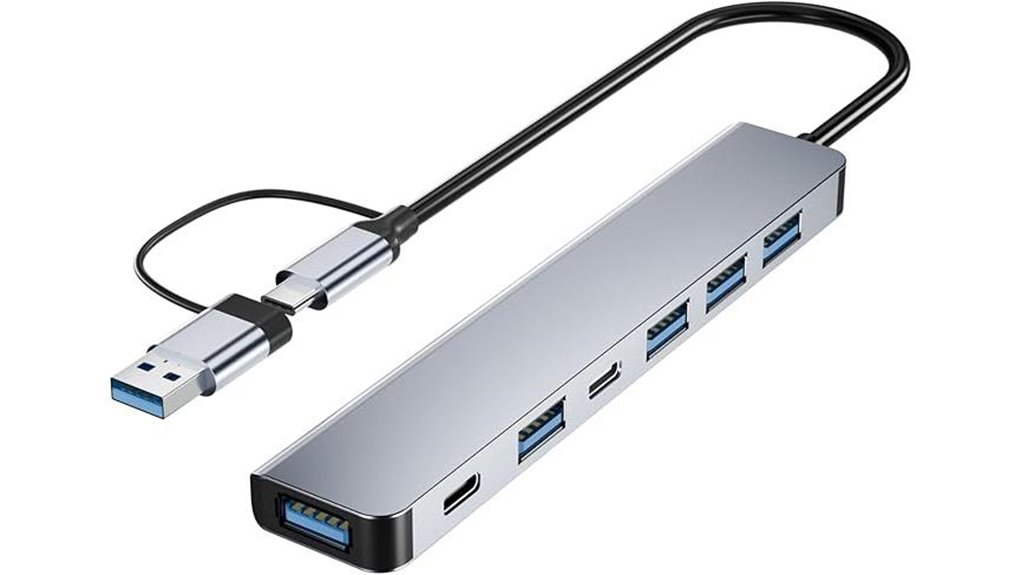
USB-A$USB-C HUB, 7Ports Hub (USB-C)
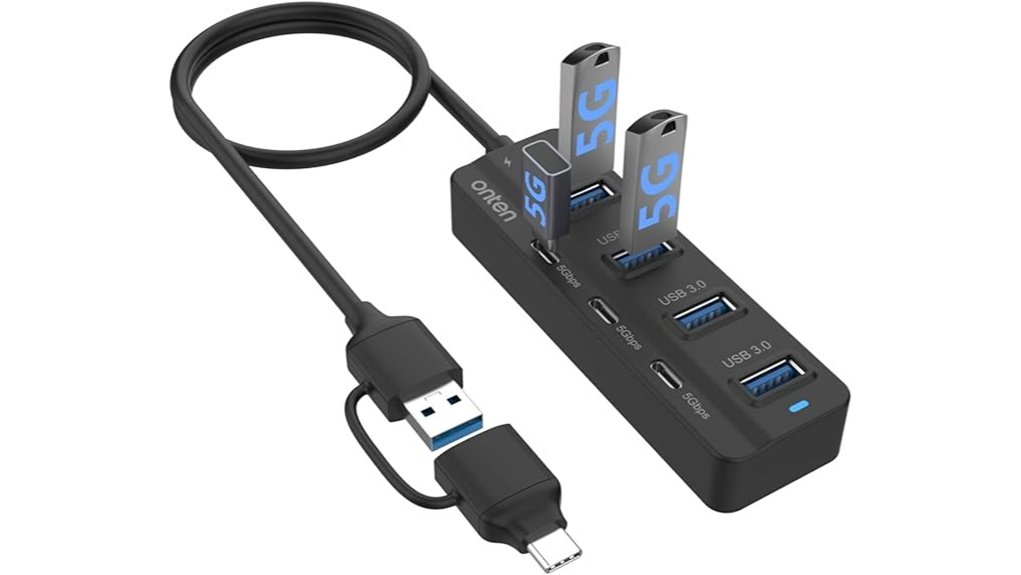
seven port usb a usb c hub

Ideal for expanding a USB-C or Thunderbolt laptop’s peripherals with seven ports—three USB-C and four USB 3.0—via a plug-and-play, data-only hub that doesn’t support Power Delivery. With three USB-C and four USB 3.0 ports, it’s a plug-and-play solution offering up to 5 Gbps and compatibility with USB-C, Thunderbolt 3, and Thunderbolt 4. No drivers required; supports Windows, macOS, Linux, iPadOS, ChromeOS. It’s data-only, so the USB-C port won’t charge laptops. A 3.2-foot cable keeps your setup tidy, while the slim 4.1 x 0.67 x 1.3-inch, 0.15 lb body stays unobtrusive. OTG lets you connect peripherals directly to USB-C devices.

Best For: Users who need a compact, data-only USB-C/Thunderbolt hub to expand peripherals on USB-C or Thunderbolt laptops without charging capability.

Pros:

  • Plug-and-play with no driver installation required on Windows, macOS, Linux, iPadOS, and ChromeOS.
  • Seven-port versatility: three USB-C and four USB 3.0 ports for broad peripheral expansion.
  • Compact, lightweight design with a 3.2 ft cable for tidy desk setups.

Cons:

  • No Power Delivery passthrough; cannot charge laptops or power connected devices.
  • Data-only hub; no monitor support or video output.
  • OTG support may vary by device; not all USB-C devices will enable OTG functionality.

https://www.amazon.com/dp/B0BXCX4J7T

WIRWTRU 7-Port USB 3.0 Hub with On/Off Switches
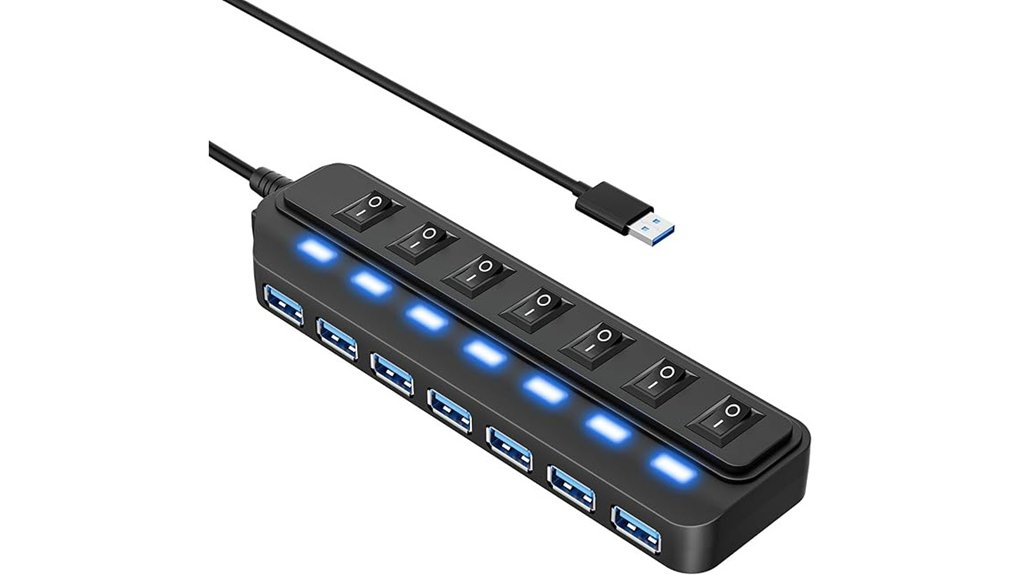
wirwtru 7 port usb hub

For anyone who needs reliable, plug‑and‑play USB expansion with precise device control, the WIRWTRU 7-Port USB 3.0 Hub shines thanks to its individual port switches. You get seven USB 3.0 ports at up to 5 Gbps, backward compatible with USB 2.0/1.0, and compatibility across PC, Mac, desktop, PS5, and Xbox. Charging isn’t supported. Each port has its own on/off switch with blue LEDs showing active status. Its compact, slim design fits ultrabooks. Includes USB extension cable; slim, light. Dimensions are 7.76 x 3.54 x 1.26 inches; weighs 5.3 ounces. Gift box packaging keeps it safe, easy to store too.

Best For: Professionals and students who need a compact, plug‑and‑play 7‑port USB 3.0 hub with per‑port on/off switches for precise device control and ultrabook portability.

Pros:

  • Seven USB 3.0 ports with data transfer up to 5 Gbps.
  • Individual on/off switches per port with blue LED indicators for easy status visibility.
  • Compact, slim design with included USB extension cable, ideal for ultrabooks.

Cons:

  • Charging not supported; cannot charge devices through the hub.
  • Bus-powered with no external power adapter, which may limit power to high-draw peripherals.
  • Lacks USB-C/Power Delivery; uses USB 3.0 only and may not be ideal for newer devices.

https://www.amazon.com/dp/B0FCXS97CG

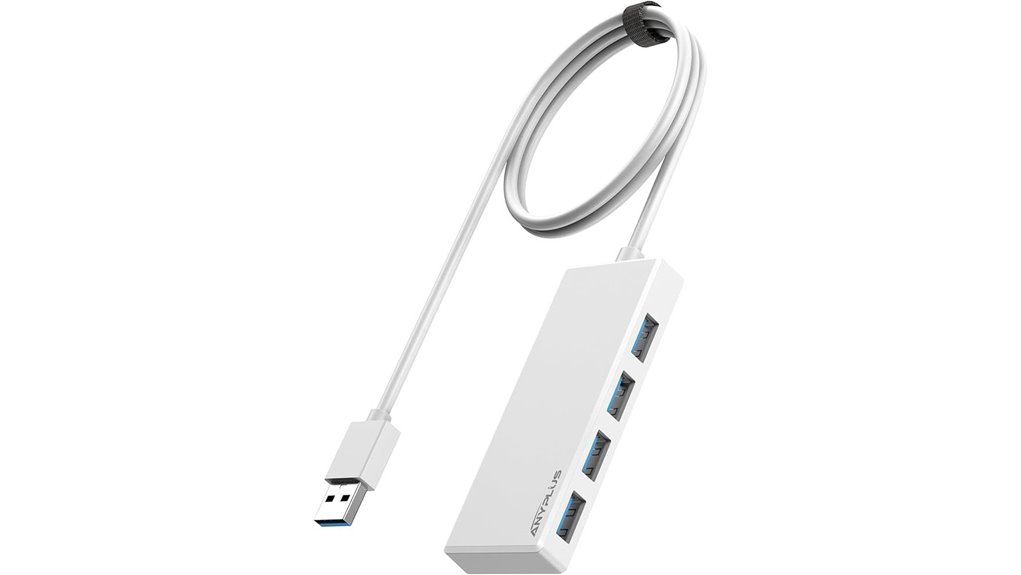
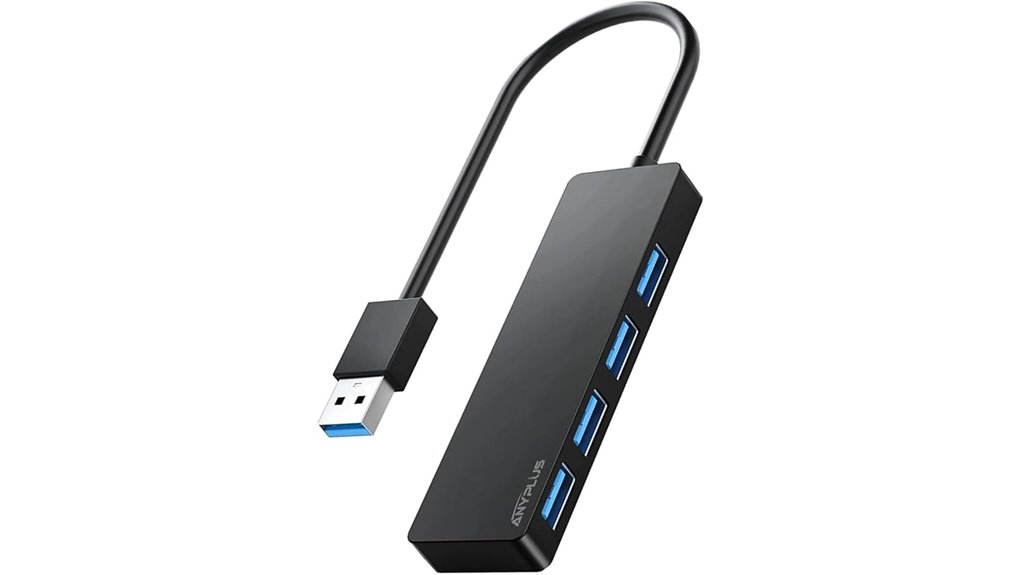
ANYPLUS USB 3.0 4-Port Hub, Portable
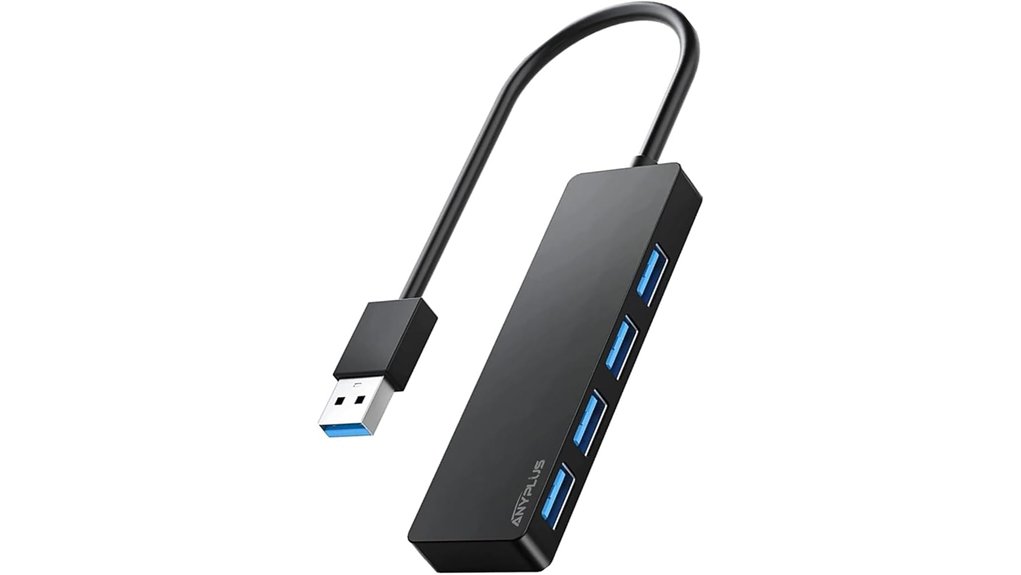
anyplus usb3 0 4 port hub

Perfect for travelers and laptop users, this compact ANYPLUS USB 3.0 4-Port Hub lets you expand a single port into four with plug‑and‑play ease and no driver required. It’s a 4-port USB 3.0 hub for data transfer and peripheral connections, not charging, with a 900mA max output.

USB 3.0 delivers up to 5Gbps, backward-compatible with USB 2.0 (480Mbps) and USB 1.1 (12Mbps). It supports Windows, macOS, Linux, Chrome OS, drives, printers, keyboards, mice, cards, and HDDs. Dimensions: 1.42 x 0.43 x 3.66 inches, 1.59 ounces. HDDs needing over 900mA require power. ASIN B0BWH9DZRV; Rank #11 in USB Hubs today.

Best For: Travelers and laptop users who need to expand a single USB port into four for data transfer and peripheral connections (not for charging).

Pros:

  • Expands a single USB port into four for multiple peripherals.
  • USB 3.0 speeds up to 5Gbps and is backward-compatible with USB 2.0/1.1.
  • Plug-and-play with no driver required; compact, travel-friendly design.

Cons:

  • Not suitable for charging; power is limited to 900mA.
  • HDDs drawing more than 900mA require an external power adapter.
  • Performance may vary with host USB port power and when multiple devices are connected.

https://www.amazon.com/dp/B0BWH9DZRV

Factors to Consider When Choosing USB Hubs for Multiple Devices

To pick the right USB hub, you first assess how many ports you need, since port count sets your expandability. Then you check power delivery limits, data speed requirements, and the hub’s compatibility with your devices, because mismatches can slow or block connections. Finally, you balance cable length considerations to keep everything tidy and reliable.

Port Count Needs

How many devices do you plan to connect at once, and how might that grow? Determine the number of devices you plan to connect simultaneously and choose a hub with at least that many ports. If you anticipate future additions, opt for hubs offering 6–8 ports to avoid needing another hub later. For external hard drives and printers, consider external power and guarantee the port count leaves room for powered devices. Ports with individual on/off switches can help manage a crowd of devices when the total port count is fixed. For high data transfer across multiple devices, guarantee the hub supports USB 3.0 or higher and that the port count minimizes bottlenecks. Choose a model with a clear port layout to simplify setup today.

Power Delivery Limits

Wondering how much power a USB hub can actually deliver to all your devices? The hub’s power source sets the ceiling: bus-powered from your computer shares power across ports, while externally powered hubs have a supply and can support more devices. For HDDs and other power-hungry gear, you’ll often want an external adapter to meet current demands and keep transfers stable. Some hubs include a PD-in port to feed the hub from a supply, but that won’t automatically charge connected devices unless the hub explicitly supports it. USB 3.0 ports can push 900 mA per port, yet real current depends on design and power source. Drawing power from many ports at once risks voltage drops and instability; match the total budget to your needs.

Data Speed Requirements

Because bandwidth is shared across all active ports, a hub doesn’t deliver the maximum USB spec on every device at once. USB 3.0 hubs top out at 5 Gbps in theory, while USB 2.0 devices peak at 480 Mbps and USB 1.1 at 12 Mbps. With several ports active, per-port speeds drop, so you won’t hit full speed on every device during simultaneous transfers.

For large-file transfers to HDDs or SSDs, USB 3.x is needed to reach practical speeds in MB/s range, though results depend on drive and cable. Peripherals like keyboards, mice, and flash drives can run on USB 2.0 or 3.0, but USB 2.0 devices cap at 480 Mbps. To sustain throughput for devices, use a hub, since power limits throttle speeds.

Compatibility Scope

Where compatibility matters most is in how a hub fits your OS, port type, and host requirements. You’ll find hubs fit Windows, macOS, Linux, and Chrome OS—with version notes—and run USB 3.0 (to 5 Gbps) while staying backward compatible with USB 2.0/1.0. You’ll find compatibility hinges on port type—USB-A versus USB-C—and host requirements; some USB-C hubs require a USB-C host or adapter, while others offer PD-in but data-only ports. Peripherals commonly supported include keyboards, mice, flash drives, printers, and external HDDs, so you can plug in work or media gear without juggling devices. Note that many hubs don’t provide charging to connected devices, so plan power needs accordingly. Some hubs advertise gaming-console or car-system use, but you must consider power, data limits for reliability.

Cable Length Considerations

How much reach do you really need from a USB hub? Cable lengths for hubs typically sit around 2 to 3 feet, with some models nudging toward 3.2 feet (about 1 meter). Extending beyond 3 feet can raise signal attenuation, risking data stability at USB 3.0’s 5 Gbps. Shorter paths reduce clutter, keep things tidy, and help preserve performance on portable setups. If you need more reach, choose a hub matching the 2–3 foot range to balance convenience and signal integrity.

Remember that longer cables can also cause voltage drop for power-hungry devices, so you’d prefer external power or a shorter data path for stability. In practice, a ~2-foot option is common on slim designs and works well for most desks in offices today.

Frequently Asked Questions

Do Hubs Provide Power Delivery for Laptops or High-Watt Devices?

Yes, some hubs provide power delivery for laptops and high-watt devices, but not all. Look for USB-C hubs with Power Delivery (PD) passthrough or a dedicated PD input. They’ll negotiate charging with your laptop and can supply up to the hub’s rated wattage, often 45–100W. If the hub is bus-powered or lacks PD, you’ll still recharge through your laptop’s charger and use data ports separately. Check the wattage and adapter.

Are USB Hubs Compatible With macOS and Windows?

Yes, a USB hub is a friendly bridge that lets macOS and Windows mingle with your gadgets. It’s usually plug-and-play, so you just connect it, and your devices wake up. Most hubs work on both macOS and Windows without extra drivers, though some features may need a specific vendor app. If you rely on distinctive peripherals, check compatibility for power delivery, charging, or fast data. Most hubs fit most setups.

Can You Daisy-Chain Multiple Hubs for More Ports?

Yes, you can daisy‑chain USB hubs, but you’ll hit limits fast. Gear three or four hubs only if you stay within USB standards and powered hubs. Each hop splits bandwidth, so high‑speed devices may slow down. Use powered hubs at the end of the chain for devices that draw power. Avoid mixing USB‑C and USB‑A hubs without checking compatibility, and keep essential devices close to the host to minimize latency.

What Is the Practical Data Transfer Limit of Hubs?

Your practical limit isn’t a single number; it’s the hub’s upstream bandwidth. On a USB 3.0 hub you share about 5 Gbps among all ports, so transfers slow as you add devices. USB 3.1/3.2 gen2 hubs offer up to 10 Gbps, still shared. In practice, expect lower real-world speeds due to overhead, device mix, and bus contention. For heavy traffic, connect devices directly or use fewer hubs in the chain.

Do USB Hubs Reliably Support USB-C PD Charging?

Yes, USB-C hubs can reliably support PD charging, but it depends on the hub’s power budget and PD implementation. If a hub includes a proper USB-C PD input or PD passthrough, you can charge your laptop or device while using peripheral ports. Cheaper hubs may throttle charging or lack true passthrough. Check the wattage rating, like 60W or 100W, and guarantee the charger matches your device’s requirements. In practice today.

Conclusion

Choosing the right USB hub means balancing ports, power, and compatibility with your setup. You’ll get smoother multitasking when you pick a powered hub for multiple devices, not just a passive one. Fun stat: 68% of users report faster, more reliable peripheral performance after switching to a powered hub, especially on laptops. So track your devices, consider whether you need USB-C or USB-A, and prioritize one with a power budget and switchable ports for control.

Top USB Hubs For Travel Laptops With Must-Have Ports

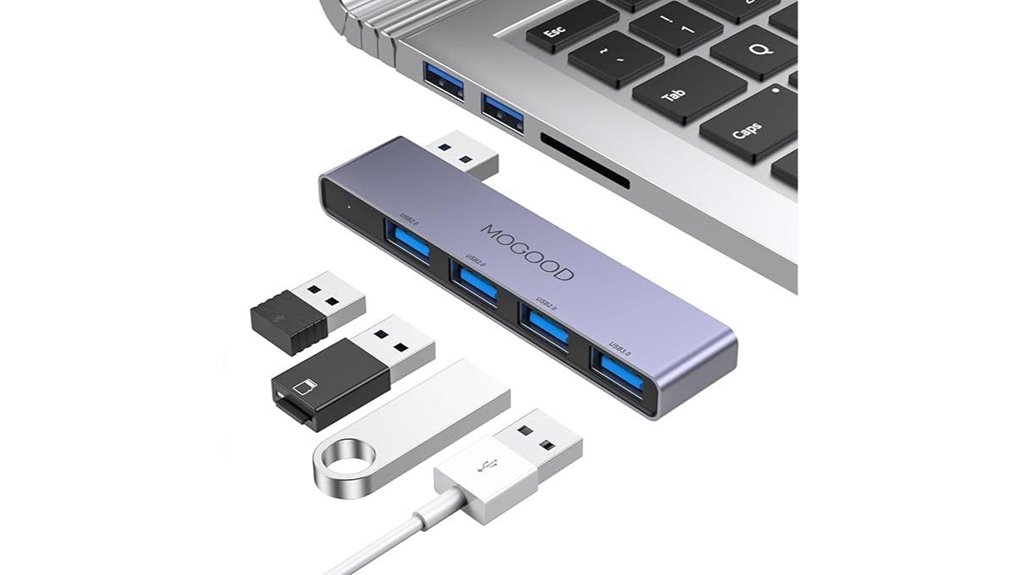
Looking for the best travel hub? Pick a MOGOOD 3.0 with one USB‑C and three USB‑2.0 ports for Chromebook use. A BerlAT 7‑in‑1 drops a USB‑C, HDMI, USB‑3.0, and Ethernet combo from laptop, while Cable Matters’ 4‑port fits in a pocket—doesn’t need power. For gaming, Sabrent’s four‑port LED hub keeps cables neat, and Acer’s 4‑port stack adds a USB‑C power inlet. Want to compare specs or deals? Check quickly the comparison for insights—you’re covered today.

Key Takeaways

  • Choose a hub with one USB‑3.0 port and at least two USB‑2.0 ports for high‑speed transfer and peripheral support.
  • Keep the hub ultra‑compact (e.g., 2.76″ × 1.97″ × 0.39″) and lightweight (~0.7 oz) so it fits easily in a laptop bag.
  • Ensure at least one port supports 5 Gbps SuperSpeed; other ports can be USB‑2.0 or USB‑C OTG.
  • Prefer a hub that draws power solely from the laptop’s USB‑C inlet (no external brick), allowing instant, driver‑free connectivity.
  • Verify cross‑platform compatibility—Mac, Windows, Chrome OS, and Linux—so the hub works with any travel laptop or mobile device.

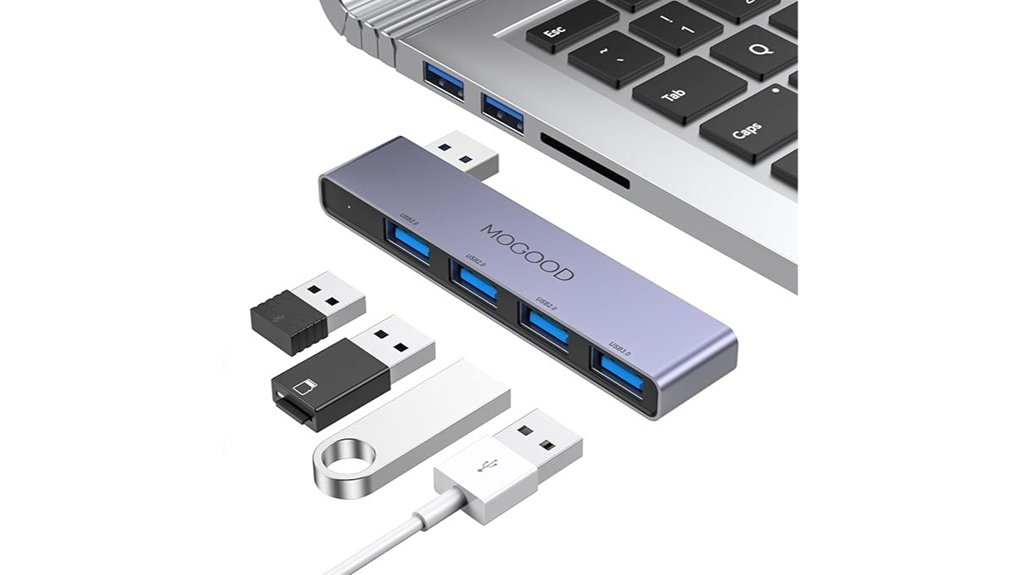
MOGOOD 3.0 USB Slim Hub (8 Ports)

mogood 3 0 eight port hub

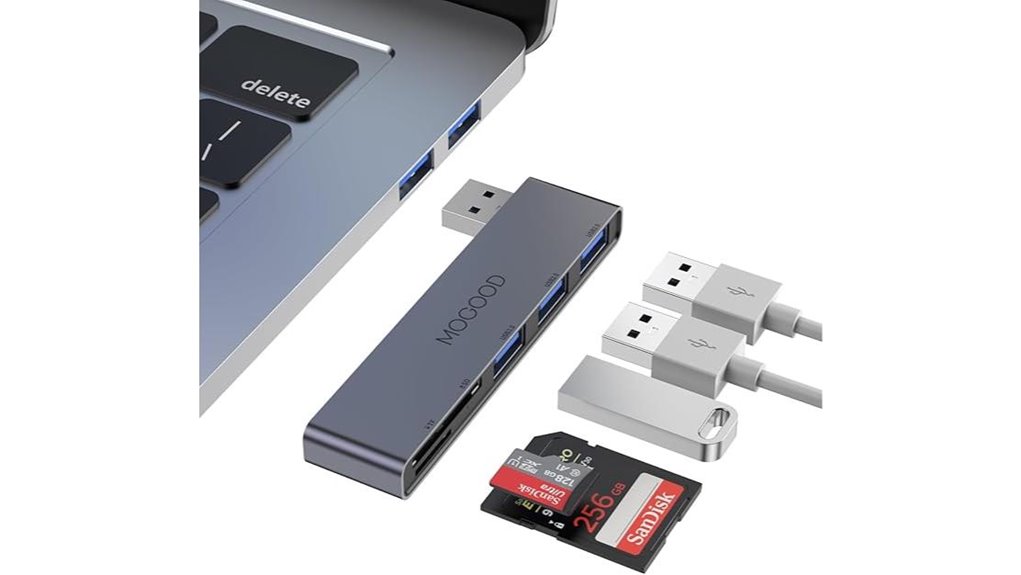
Who’s looking for a 3.0 hub that won’t add bulk to a travel‑ready laptop? The MOGOOD 3.0 USB Slim Hub delivers just that. It shrinks to 2.76″ × 1.97″ × 0.39″ and weighs only 0.704 oz, so your ultrabook stays light. This portable splitter gives you one lightning‑fast USB‑3.0 port and three 480 Mbps USB‑2.0 slots—enough to plug a flash drive, HDD, mouse, or keyboard simultaneously. Compatible with USB‑C laptops, MacBook Pro 2019‑22, Chromebook, and Android devices, it’s plug‑and‑play with no drivers. The OTG support lets you connect a phone or tablet directly. Warranty is handled by MOGOOD through official retailers today.

Best For: travelers, ultrabook users, and anyone needing one fast USB‑3.0 port and three USB‑2.0 slots without adding bulk.

Pros:

  • Ultra‑compact size (2.76″ × 1.97″ × 0.39″) and light weight (0.704 oz).
  • Plug‑and‑play, no drivers or software required.
  • OTG support lets you connect phones/tablets directly.

Cons:

  • No charging capability, so it can’t provide power to connected devices.
  • Limited to one USB‑3.0 port only.
  • Only three USB‑2.0 slots, which may be insufficient for heavy multitasking.

https://www.amazon.com/dp/B0BCHZG1PJ

BerlAT 7-in-1 USB-C Hub (Aluminum, USB 3.0)

usb c 7 in 1 aluminum hub

If you need a compact, lightweight hub to power your travel laptop, the BerlAT 7‑in‑1 USB‑C hub meets the bill: a sturdy aluminum alloy case, 5 Gbps USB‑3.0 transfer, and seven versatile ports that fit Macs, Windows laptops, Android tablets, and even gaming consoles. You’ll get one USB‑3.0 port for external drives, four USB‑2.0 ports for peripherals, and two USB‑C ports for OTG adapters. The 4×1×0.5‑inch, 1.41‑oz frame houses a retractable aluminum chassis that’s both sturdy and sleek without bulk. It is compatible with MacBook, Windows, Android, and gaming consoles, delivering a versatile companion that handles your daily data needs.

Best For: travelers, student laptop users, and casual gaming setups that need a compact, lightweight hub to connect multiple peripherals and external drives without extra bulk.

Pros:

  • Durable aluminum alloy housing that’s both sturdy and ultra‑light (1.41 oz).
  • 5 Gbps USB‑3.0 port plus four USB‑2.0 ports for drives, keyboards, mice, and OTG adapters.
  • Small footprint (4 × 1 × 0.5 in) with a retractable chassis ideal for on‑the‑go use.

Cons:

  • Four USB‑2.0 ports offer only 480 Mbps, limiting speed for high‑tier peripherals.
  • No USB‑C Power Delivery, so it cannot charge laptops or power‑heavy devices.
  • Lacks HDMI/DisplayPort and SD card slots, which may be required for some users.

https://www.amazon.com/dp/B0DBTFLPJP

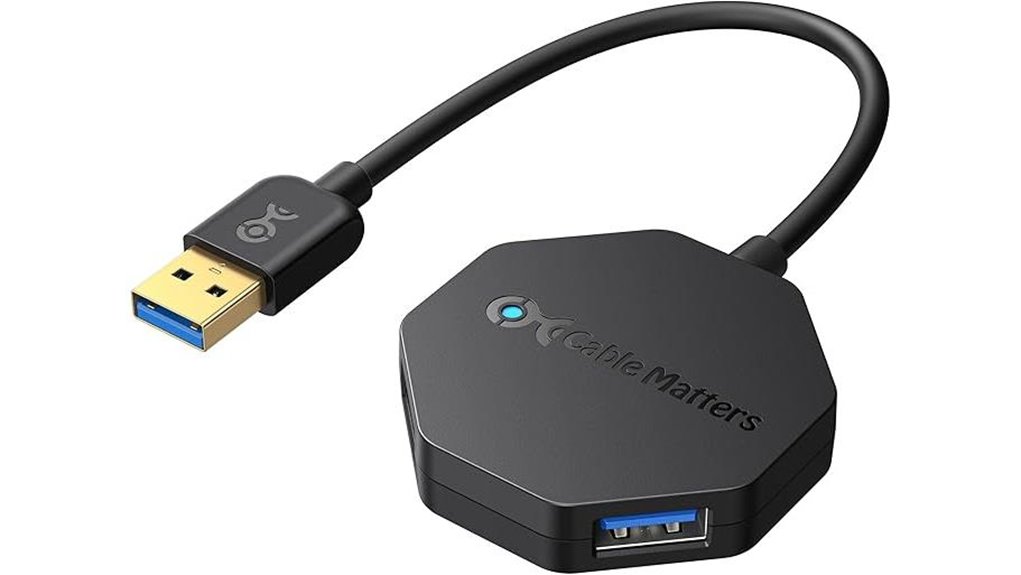
Cable Matters Ultra Mini 4 Port USB Hub (USB 3.0 Hub, USB3 Dock)

4 port usb 3 0 hub

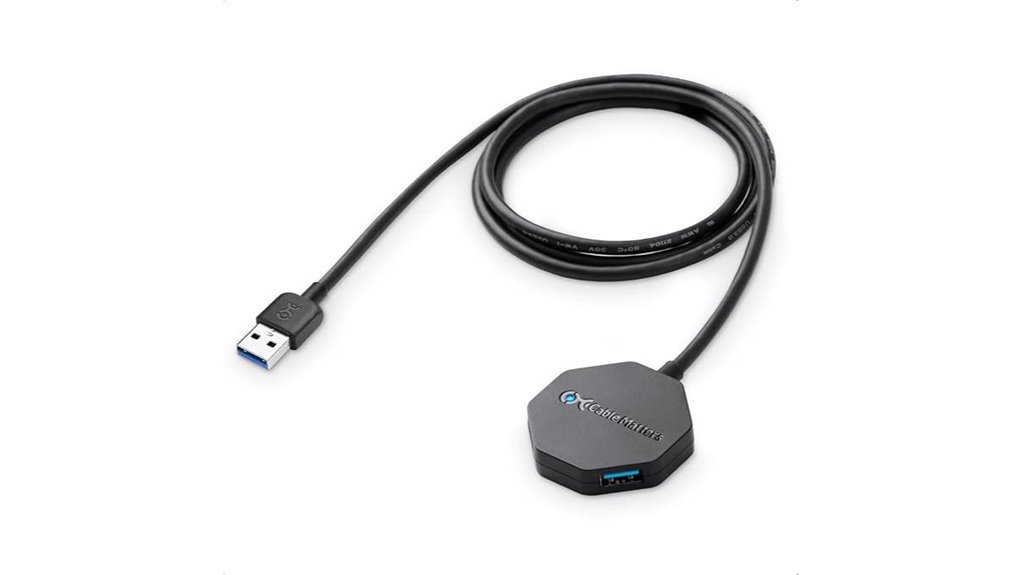
The Cable Matters Ultra Mini 4‑Port USB Hub packs every port you need into a paper‑thin, 1‑oz package that you can slip into a travel bag or even a pocket without adding bulk. It turns one laptop USB port into four, letting you power a printer, mouse, USB‑C charger, and flash drive. The hub weighs 1 oz (adapter) and 1.44 oz total, measuring 2 × 2 × 0.4 in. Built‑in over‑current protection and molded strain‑relief connectors keep devices safe and the hub durable. Its 5‑inch flexible tail tucks neatly into your bag, while bus‑powered design requires no external brick, and it delivers USB 3.0 SuperSpeed at 5 Gbps.

Best For: travelers, mobile professionals, or anyone who needs a lightweight, portable way to expand a single laptop USB port into multiple connections without carrying an external power adapter.

Pros:

  • Ultra‑compact, 1‑oz design ideal for travel and pocket use.
  • Bus‑powered with built‑in over‑current protection for device safety.
  • USB 3.0 SuperSpeed (5 Gbps) delivers fast data transfer across all four ports.

Cons:

  • No external power supply limits use with high‑demand devices such as external hard drives.
  • All four ports share a single USB 3.0 bus, which can become a bottleneck if saturated simultaneously.
  • The flexible tail can be cumbersome to detach in tight spaces or when the hub is joined to a device.

https://www.amazon.com/dp/B00PHPWLPA

SABRENT 4-Port USB 3.0 Hub, 2ft LED Switches

4 port usb led switch

You’ll love the 2‑foot flexible cable that keeps the hub’s four USB‑3.0 ports within arm’s reach, letting you swap devices on the fly while you’re on the go. Its slim chassis weighs just 2.2 oz, fitting comfortably into a travel bag. Each port has a dedicated LED that instantly shows power status, and an on/off switch lets you heat‑swap peripherals without rebooting. With 5 Gbps transfer speed, the hub handles large files quickly, yet remains compatible with USB 2.0/1.1 equipment across Windows, macOS, and Linux. No drivers, no charging—just plug, flash, and go. You’ll find it indispensable for weekend conferences and meetings.

Best For: traveling professionals who need quick, driver‑free access to multiple high‑speed USB‑3.0 devices on the go.

Pros:

  • 2‑ft flexible cable keeps ports within arm’s reach and facilitates on‑the‑fly hot swapping.
  • Individual LED status indicators and dedicated on/off switches let you control power without rebooting or installing drivers.
  • 5 Gbps USB‑3.0 throughput transfers large files rapidly while remaining compatible with USB‑2.0/1.1 peripherals across Windows, macOS, and Linux.

Cons:

  • Lacks charging capability, so it cannot provide power to devices that need it.
  • Limited to only four ports, which may be insufficient for larger setups or multiple peripherals.
  • Not compatible with newer USB‑4 or Thunderbolt ports, restricting use to older standards.

https://www.amazon.com/dp/B00JX1ZS5O

Acer 4-Port 3.0 Hub with Type C Power

acer 4 usb 3 0 c powered

Four USB 3.0 ports, all powered by a single 5 V USB‑C inlet, give you lightning‑fast data transfer up to 5 Gbps while keeping the hub lightweight at just 2.89 oz. You’ll plug it into your laptop’s USB‑C and get four additional USB‑A sockets for any drive, keyboard, or mouse. Its slim black housing, 4‑ft cable, and LED status light keep it travel‑ready. The built‑in GL3510 controller and passive cooling guarantee hot‑plug safety, while no drivers mean instant plug‑and‑play. It works across macOS, Windows, Chrome OS, and Linux, and even pairs with gaming consoles. As you have a USB‑C port, you easily stay connected.

Best For: users who need a compact, driver‑less solution to expand a single USB‑C port into four fast USB‑3.0 connections for peripherals or external drives.

Pros:

  • Ultra‑fast 5 Gbps data transfer on every port.
  • Ultra‑lightweight (2.89 oz) and slim black design fits laptops and portable setups.
  • Plug‑and‑play with no driver installation required on macOS, Windows, Chrome OS, or Linux.

Cons:

  • Limited to 5 V USB‑C inlet, so it cannot charge devices.
  • No USB‑C data or power output, only passive expansion to USB‑A ports.
  • Absence of additional feature controls (volume, power switch) may be limiting for power‑management want.

https://www.amazon.com/dp/B0CPSTG4N3

UGREEN 4-Port USB 3.0 Slim Hub

ugreen 4 port usb3 hub

If a single USB‑A port feels cramped, UGREEN’s 4‑port slim hub expands your connectivity without compromising portability. Weighing just 33 grams and measuring only 0.4 inch thick, this black hub fits comfortably beside your travel laptop. The 3.3‑ft cable keeps you anchored, while its compact 9.8 × 7.8 × 3.1 in footprint lets you slip it into a briefcase. Four USB A ports let you plug in a mouse, keyboard, flash drive, or printer—all at 5 Gbps. A 10‑GB transfer takes about 16.4 seconds. Plug‑and‑play works on Windows, macOS, Linux, Chrome OS, even Xbox Series and PS5. Released December 6, 2023, it comes with a standard warranty and a hassle‑free 30‑day return policy.

Best For: The product is best for digital nomads, students, and gamers who need a lightweight, high‑speed USB hub that fits easily into a backpack or desk setup and works across Windows, macOS, Linux, and gaming consoles.

Pros:

  • Ultra‑compact, 0.4‑inch thick design weighs only 33 g for easy portability.
  • 5 Gbps USB 3.0 transfer speeds (10 GB in ~16 s) keep data flow fast.
  • Plug‑and‑play compatibility on Windows, macOS, Linux, Chrome OS, Xbox Series, and PS5—no drivers needed.

Cons:

  • No power‑delivery or USB‑C input, so it can only be powered from the host’s USB‑A port.
  • 3.3‑ft cable might be too short for some desk or laptop‑mount setups.
  • Four USB‑A ports can crowd a limited workspace, possibly creating cable clutter.

https://www.amazon.com/dp/B0CPF28PS5

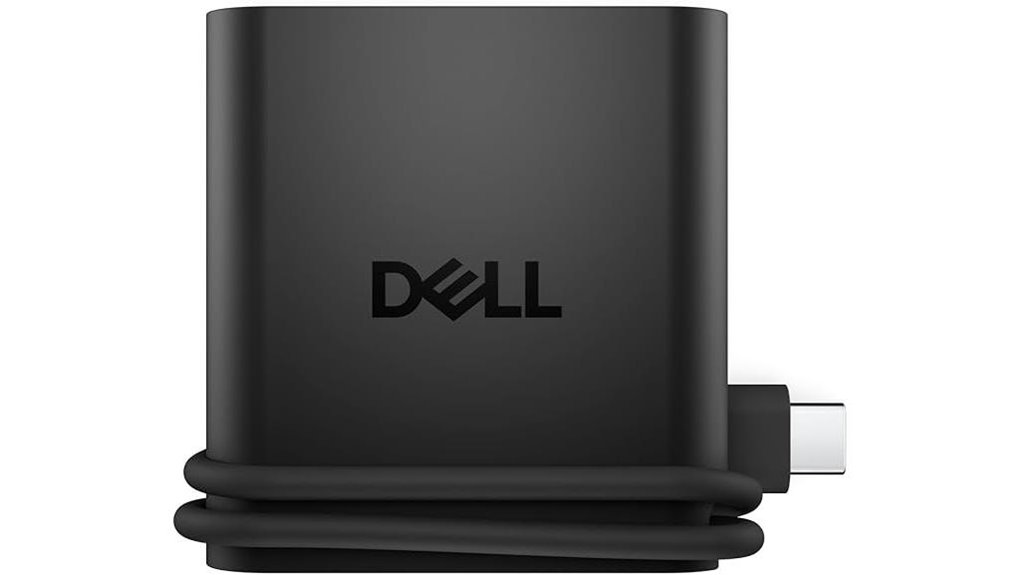
Dell Pro 4-in-1 USB-C Travel Hub DA225

dell pro 4 in 1 hub

The Dell Pro 4‑in‑1 USB‑C Travel Hub DA225 brings world‑first Smart Power Management to the traveler’s bag. You’ll appreciate its slim, lightweight design and 10.63‑in cable that folds neatly into most laptop sleeves. With two USB‑C, one USB‑A, and an HDMI port that supports 4K at 60 Hz, it delivers versatile connectivity. Embedded tech rebalances power, preventing over‑consumption, and tracks real‑time usage. You’ll receive instant notifications on device status and power alerts, keeping you in control throughout the trip. Plug‑and‑play operation means you can focus on work and travel without hassle. Use it daily, and always experience smarter power habits.

Best For: frequent travelers who need a lightweight hub with power monitoring to keep devices running efficiently.

Pros:

  • Slim, lightweight design with a 10.63‑inch cable that fits easily in laptop sleeves.
  • World‑first Smart Power Management that rebalances power and prevents over‑consumption.
  • Plug‑and‑play operation with instant device status notifications and 4K @ 60 Hz HDMI support.

Cons:

  • Limited to only one USB‑A port, which may be insufficient for multitasking.
  • Higher price point compared to basic hubs.
  • Lacks additional ports such as Ethernet or SD card reader for full connectivity.

https://www.amazon.com/dp/B0FQXHW8BV

USB-C 7-in-1 Hub 4K HDMI 100W PD

usb c 7 in 1 4k hub

When you’re on the go, this USB‑C 7‑in‑1 hub keeps your travel laptop ready for work, play, and power—all while staying under 40 g. You plug the hub into your laptop’s USB‑C port and instantly enable a 4K HDMI output that delivers 30 Hz to monitors, TVs, or projectors. The 100 W Power Delivery port charges your MacBook, Dell XPS, or Surface while you work – no data trickle, just pure charging. Two USB‑3.0 ports support 5 Gbps transfers, and a USB‑2.0 slot covers legacy devices. A 1‑TB TF/SD card reader gives you quick media access on the fly. Aluminum chassis cuts heat.

Best For: traveling laptop users who need a lightweight, all‑in‑one solution for high‑resolution display, fast file transfer, and fast charging on the go.

Pros:

  • 4K HDMI output (30 Hz) for high‑definition displays
  • 100 W Power Delivery to charge laptops, tablets, and phones
  • Dual USB‑3.0 ports (5 Gbps) plus legacy USB‑2.0 for versatile connectivity

Cons:

  • 30 Hz refresh limits use with gaming or high‑frame‑rate content
  • The PD port does not transfer data, requiring extra ports for peripherals
  • No support for 4K@60 Hz, limiting HDR or ultra‑high‑definition use in some setups

https://www.amazon.com/dp/B0DWF2N8WB

Cable Matters Ultra Mini 4‑Port USB 3.0 Hub

compact 4 port usb hub

Seeking a pocket‑sized powerhouse to expand your laptop’s connectivity on the go? The Cable Matters Ultra Mini 4‑Port USB 3.0 Hub (model 202072‑BLK) delivers SuperSpeed USB 3.0 ports, pushing up to 5 Gbps—ten times faster than USB 2.0—yet it stays backward‑compatible. Bus‑powered, it needs no adapter, and its built‑in over‑current protection keeps devices safe. Its octagonal, collapsible housing folds neatly beside your laptop, while a 4‑ft flexible cable tail slides inside. Strain‑relief connectors increase durability, and its 48 × 48 × 12 mm size weighs just 2.39 oz, making it ultra‑portable. Warranty and support are available through Cable Matters. Power keyboards, mics, or external drives while traveling.

Best For: travelers, commuters, and laptop users who need quick, portable expansion for keyboards, microphones, or external drives without an external power supply.

Pros:

  • Compact octagonal design collapses to fit in a pocket, keeping your lap top tidy.
  • Built‑in over‑current protection safeguards all connected devices.
  • USB 3.0 SuperSpeed ports deliver up to 5 Gbps, providing ten‑times faster data transfer than USB 2.0 while remaining backward compatible.

Cons:

  • Bus‑powered only; it may struggle to power devices that draw more current than the hub can provide.
  • With no external power adapter, you cannot connect multiple high‑draw peripherals simultaneously.
  • Limited to four ports, so it may not meet the needs of users requiring more extensive expansion.

https://www.amazon.com/dp/B09TBM4Q8K

MOGOOD 5-Port USB 3.0 Hub with Card Reader

mogood five port cardreader hub

If you’re constantly on the go, you’ll love how the MOGOOD 5‑Port USB 3.0 Hub instantly expands a cramped laptop port bar into a portable powerhouse. It mixes a single fast 5 Gbit/s USB 3.0 port with two reliable USB 2.0 slots, plus three extra USB‑A ports for peripherals. Its integrated SD/TF card reader covers SD, SDHC, SDXC, and micro‑SD, read‑only one at a time, and never needs drivers. Lightweight aluminum alloy keeps it sturdy; dimensions measure 6.54 × 2.4 × 0.39 inches, weighing just 1.13 oz. Compatible with Windows, macOS, iOS, and Linux, it also plugs into gaming consoles like Xbox and PS5 for quick transfers today.

Best For: Professionals and travelers who need a compact, driver‑free hub for fast USB 3.0 data transfer and versatile card reading on the go.

Pros:

  • Lightning‑fast 5 Gbps USB 3.0 port for rapid backups and file transfers.
  • Integrated SD/TF card reader supports all major card formats (SD, SDHC, SDXC, micro‑SD).
  • Durable aluminum alloy body, lightweight (1.13 oz), and plugs into Windows, macOS, Linux, iOS, and gaming consoles.

Cons:

  • Only one high‑speed port; cannot transfer multiple large files simultaneously.
  • Card reader accepts one card at a time; dual‑card setups are not supported.
  • Limited to two USB 2.0 ports—adequate for basic peripherals but may require additional hubs for many devices.

https://www.amazon.com/dp/B0CG6F4QYF

USB 3.0 Hub, 5‑Pin USB‑C Extender

usb 3 0 5 pin extender hub

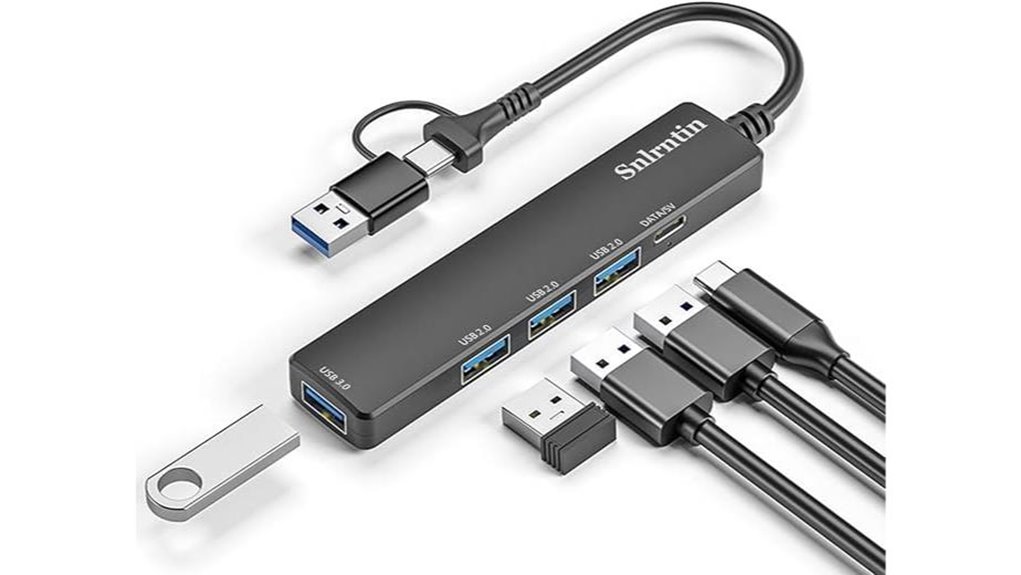
For the traveler who needs a lightweight, high‑speed hub on the go, this 5‑Pin USB‑C extender delivers a solid 5 Gbps USB 3.0 port plus three USB 2.0 ports without adding bulk, so you’ll keep moving without sacrificing transfer speed. The single USB‑C data port plugs into your laptop’s charger port, economizing space while connecting up to four peripherals via the 1 Gbps USB 3.0 and 480 Mbps USB 2.0 sockets. Its 900 mA power limit keeps connections stable when streaming or recording, but avoid overloading it with power‑hungry devices. Designed for the 8×2×2‑inch, 1‑oz. form, this hub excels anywhere—from cafés to outdoor conferences—without demanding drivers today.

Best For: Travelers and professionals who need a compact, high‑speed USB hub that fits easily into a laptop bag without requiring drivers.

Pros:

  • Ultra‑light (1 oz.) and slim (8×2×2 in.) for effortless portability.
  • 5 Gbps USB 3.0 port plus three USB 2.0 ports—fast file transfers on the go.
  • Plug‑and‑play across Windows, macOS, Linux, and legacy USB devices.

Cons:

  • No charging capability; only data transfer.
  • 900 mA power limit limits use of high‑draw peripherals.
  • Single USB‑C data port—no spare USB‑C slot for adapters or hub expansions.

https://www.amazon.com/dp/B0D12T8GDW

Upgrow 4-Port USB 3.0 Hub with Power Port

usb 3 0 four port power

With its built‑in power port, this tiny 3‑port hub doesn’t drain your laptop’s battery when you plug in flash drives, phones, and external drives. The Upgrow HU‑XI‑68 delivers 5 Gbps across three USB 3.0 ports while the dedicated power port charges the hub itself, sparing your laptop. Its 3.41″ × 1.18″ × 0.60″ footprint keeps a 1.44‑oz kit ultra‑portable, and its plug‑and‑play design works on Windows, macOS, Linux, iPad, and Android, with no drivers. You benefit from an 18‑month warranty plus a 100 % satisfaction refund/replace guarantee, and Amazon’s 30‑day return policy. It fast‑charges mobiles for 5 years and supports USB 3.0, 2.0, 1.1 devices daily.

Best For: people who need extra USB 3.0 ports on a laptop or desktop while keeping battery life intact, such as travelers, remote workers, and home office users.

Pros:

  • Ultra‑portable design (3.41″ × 1.18″ × 0.60″, 1.44 oz) with non‑draining power port.
  • Fast 5 Gbps transfer across three USB 3.0 ports, fully plug‑and‑play with no drivers.
  • 18‑month warranty, 100 % satisfaction refund/replace guarantee, and Amazon’s 30‑day return policy.

Cons:

  • Only three data ports, may not suffice for users needing more simultaneous connections.
  • Dedicated power port requires an extra USB cable; not always convenient when only one port is available.
  • Designed for low‑power devices; may not support very high‑current external drives without additional power.

https://www.amazon.com/dp/B08J7SFMRH

USB 3.0 2ft Multiport Hub & Extender (White)

white 2ft usb3 0 hub

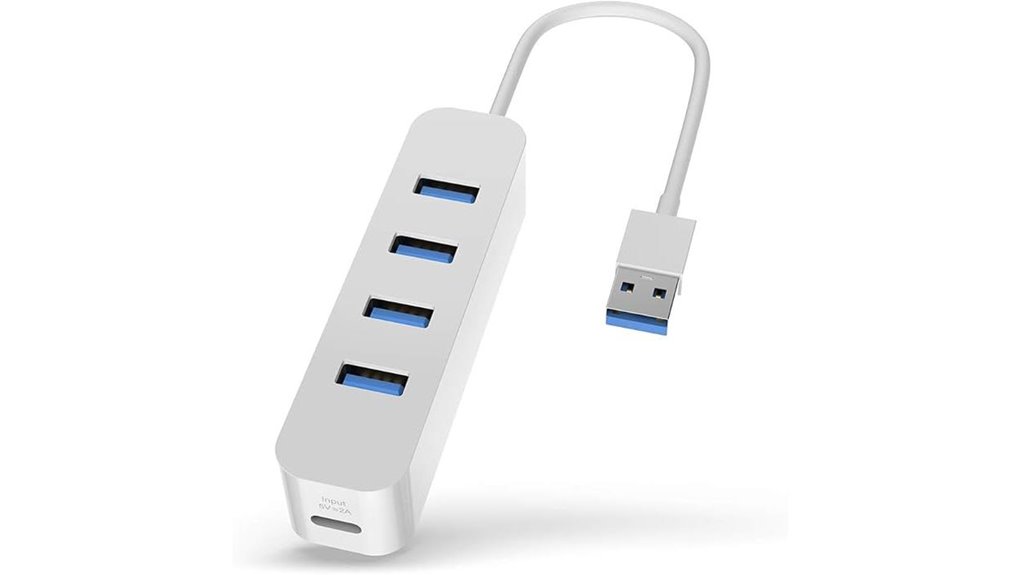
The 2‑ft ANYPLUS USB 3.0 hub, with its lightweight white design and built‑in Velcro cable, lets you plug in multiple peripherals on the go without cluttering your travel laptop—ideal for business trips or remote work where space and speed matter. It offers four USB 3.0 ports that run at 5 Gbps, yet it delivers a 900 mA per port—great for data‑heavy drives but not for charging. The 2‑ft cable stays flexible, and its Velcro fastening keeps it cleanly tangle‑free whether you’re on a plane or in a hotel meeting. Compatible with Windows, macOS, Linux and Chrome OS, this white hub fits into travel setup.

Best For: travelers and remote workers who need a compact, portable USB 3.0 hub for fast data transfer without bulk.

Pros:

  • Ultra‑compact size and lightweight (1.41 oz) for easy carry.
  • 4 high‑speed USB 3.0 ports delivering 5 Gbps data rates.
  • Versatile cross‑platform compatibility (Windows, macOS, Linux, Chrome OS).

Cons:

  • Limited to 900 mA per port, so not suitable for charging high‑power devices.
  • Only four ports, which may be insufficient for multiple peripherals.
  • No built‑in power supply or active cooling, so can warm slightly under heavy load.

https://www.amazon.com/dp/B0D7HL7MB5

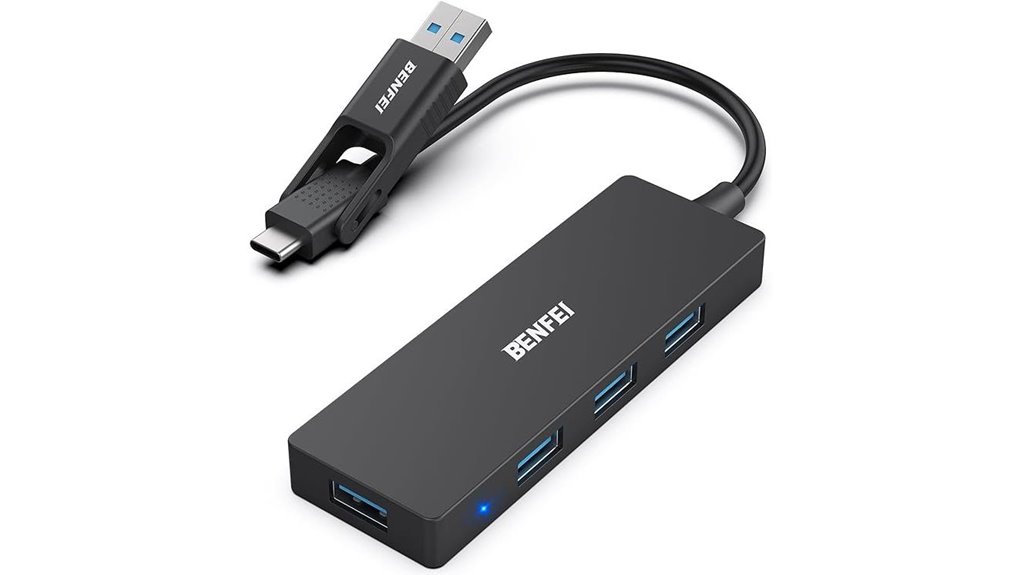
BENFEI 4-Port USB 3.0 Hub

benfei 4 port usb3 hub

If you’re a traveler looking to expand connectivity without adding bulk, the BENFEI 4‑Port USB 3.0 Hub delivers four high‑speed ports in a 1.41‑ounce, sleek black design. It plugs into your laptop’s USB‑C or a USB‑3.0 port and opens a mini‑desktop with four Type‑A ports. Windows, macOS, and Linux systems recognize it automatically, letting you run flash drives, external drives, card readers, keyboards, mice, printers, phones, and webcams. Transfers hit 5 Gbps—times faster than USB 2.0—while the cable endures over 10,000 bends. The wave‑soldered chassis keeps it lightweight yet sturdy. Though it won’t charge devices, the 18‑month unconditional warranty covers all defects.

Best For: frequent travelers, mobile office users, and gadget enthusiasts who need ultra‑lightweight, high‑speed USB expansion on the go.

Pros:

  • Ultra‑light 1.41 oz body keeps the hub discreet and portable.
  • Four USB 3.0 ports deliver 5 Gbps transfer speeds for rapid data access.
  • Durable >10,000‑bend cable and 18‑month unconditional warranty ensure long‑term reliability.

Cons:

  • No power delivery—cannot charge devices or power high‑draw peripherals.
  • Requires a USB‑C or USB‑3.0 port; not compatible with older USB‑2.0‑only laptops.
  • Lacks a built‑in power supply, so powered external drives need a separate 30 W+ USB‑C charger.

https://www.amazon.com/dp/B0BRSXHC6J

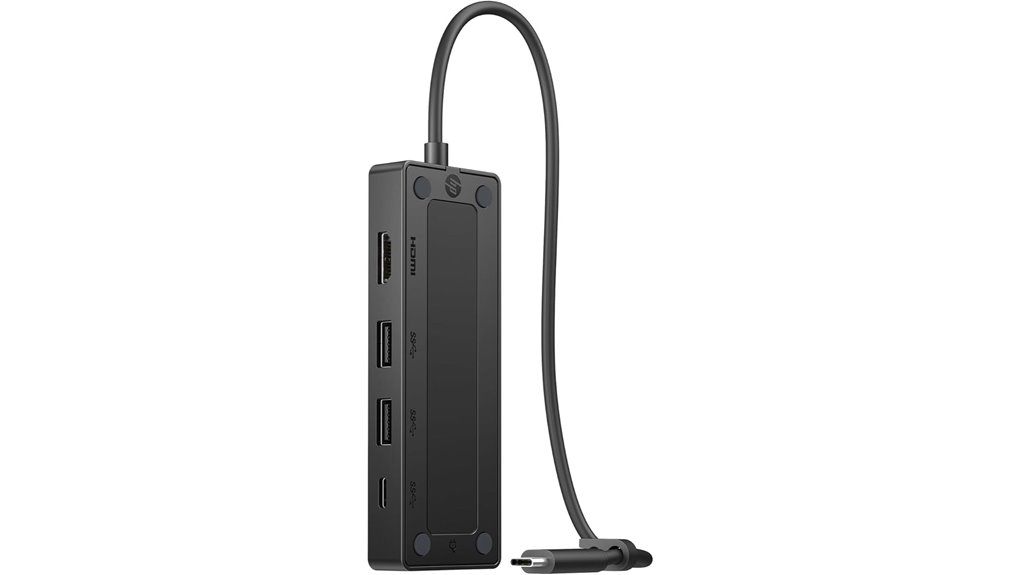
HP G3 5-Port USB-C Hub with 4K HDMI

hp 5 port 4k hub

Need a compact hub that keeps you connected on the go? The HP G3 5‑Port USB‑C Hub (86T46AA) measures just 7.01×2.36×1.5 inches and weighs 4.2 oz, fitting neatly into any travel bag. It offers two high‑speed USB‑C ports at 10 Gbps, two standard USB‑A ports, and a 4K HDMI port that runs at 60 Hz—perfect for presentations or streaming. Plug‑and‑play means no drivers; it works across Windows, macOS, Chrome OS, iOS, and Android. Energy flows through the host’s USB‑C passive power, or you can use your laptop’s 65 W/90 W adapter for charge. Built from ≥80 % post‑consumer recycled plastic, the HP G3 combines portability with sustainability.

Best For: remote workers, frequent travelers, and students who need a lightweight, all‑in‑one connection solution for multiple devices on the go.

Pros:

  • Ultra‑compact size (7.01 × 2.36 × 1.5 in) and only 4.2 oz weight for on‑the‑go use.
  • Dual high‑speed USB‑C ports (10 Gbps), two USB‑A ports, and a 4K HDMI 60 Hz for versatile connectivity.
  • Plug‑and‑play, cross‑platform (Windows, macOS, Chrome OS, iOS, Android) with no drivers and 80 %+ recycled plastic.

Cons:

  • Requires a separate charger or the host’s power for full functionality; no built‑in battery.
  • Limited to a single 4K HDMI 60 Hz output; not supported for higher resolutions or dual 4K displays.
  • PD pass‑through depends on the host’s power delivery, which may not support full 65 W or 90 W charging for high‑draw laptops.

https://www.amazon.com/dp/B0F9LPSJMQ

Factors to Consider When Choosing USB Hubs for Travel Laptops (Ports That Matter)

First, you should check how many ports the hub offers and what types—USB‑A, USB‑C, HDMI, SD card slots—to match your device’s needs. Next, look at the data transfer rates and power delivery specs to guarantee fast connections and sufficient charging for your laptop. Finally, consider the cable length, build quality, and plug‑and‑play compatibility so the hub stays portable and works out of the box.

Port Quantity & Variety

How many ports keep your workflow humming while you’re on the move? A travel‑ready hub should give you at least one USB 3.0 slot so you can plug in high‑speed gear without bottlenecks, while the rest stay USB 2.0 for keyboards and mice. Adding a data‑capable USB‑C port lets you tether a second laptop, camera, or dock, expanding utility. With four ports, you can run a keyboard, a mouse, a flash drive, and an external drive simultaneously; each USB 3.0 channel stays independent at up to 5 Gbps. Variety matters: mixing USB A and USB‑C sockets covers legacy printers and new phones in one compact kit. Considering extra 480 Mbps USB‑2.0 ports, a five‑port hub often gives the best balance of convenience and productivity for frequent travelers during every trip.

Data Transfer Rates

Because your travel laptop’s performance hinges on how quickly data moves, picking a hub that delivers the right bandwidth is key. USB 3.0 offers 5 Gbps, ten times faster than the old USB 2.0. USB 3.1 Gen 1 retains that up to 10 Gbps, and USB 3.2 can push 20 Gbps by pairing lanes. That means a 5 GB file slips through in about eight seconds on a pure 5 Gbps line. Yet if multiple ports draw simultaneously, each port earns only a portion of the bus slice, lowering real throughput. Focus on hubs that expose full‑speed lanes per port—especially for raw‑speed external drives or high‑res media. When you move between locations, a consistent, high‑bandwidth hub keeps your workflow smooth, preventing bottlenecks that could stall transfers or sync processes daily for you every time today.

Power Delivery Support

If you need to keep your travel laptop powered while using peripherals, the hub’s Power Delivery (PD) capability is essential. A good hub can deliver up to 100 W (20 V × 5 A), giving you enough juice to recharge almost any ultrabook while still offering multiple data ports. Because PD ports typically don’t handle data, make sure the hub exposes a separate USB‑C or USB‑A port for networking and other peripherals. Match the hub’s output wattage to your laptop’s power needs; a 65 W hub will only fully charge models that require 65 W or less, leaving larger systems under‑charged. Some PD hubs offer adjustable voltage rails from 12 V to 20 V, letting you use them with older MacBooks or newer 100 W chargers without risk. Keep the hub’s voltage range within limits.

Cable Length & Build

Choosing the right cable length is key to keeping a travel hub slim, so you’ll be able to slip it into a laptop sleeve without snagging. 2‑foot to 4‑foot options give you flexibility, while a slim 10.6‑inch (≈0.27 m) cable keeps the unit compact. Most travel‑ready hubs stay under 33 g, and a 5‑inch flexible tail folds back into the chassis, preventing tangles and maintaining a low profile in backpacks. Integrated heat‑sinks and retractable housings keep the hub durable and cool without adding weight—often staying below 1 oz. Solid aluminum or high‑strength plastic frames give a chassis thickness of ~0.39 in, balancing rigidity with portability. You’ll appreciate the minimal bulk because the chassis stretches just enough to house all ports, yet resists bending when you slide it into a bag.

Plug‑and‑Play Compatibility

Ever wondered what makes a USB hub truly plug‑and‑play? You’ll find that it’s all about instant recognition across Windows, macOS, Linux, and Chrome OS—no driver installs, and devices appear within two seconds of plugging in. Certified USB 3.0 controller chips, like those from Silicon Labs or FTDI, enforce 5 Gbps data rates on every downstream port. Because the hub stays fully USB 3.0/USB‑2.0 compliant, a mouse, keyboard, flash drive, or external HDD becomes immediately available, no reboot required. If your laptop lacks a USB‑C port, OTG‑enabled hubs still work as bus‑powered peripherals, needing no extra software. A true plug‑and‑play device usually supports up to four simultaneous connections, each instantly accessible to the host. That means you can jump straight into work or entertainment without a moment’s pause.

Frequently Asked Questions

Do USB Hubs Support Simultaneous 4K Video and Charging?

Yes, many modern USB‑C hubs can drive a 4K display and charge your laptop at the same time, but only if they’re specifically rated for it. Look for a hub that lists 60 W or higher USB‑Power Delivery and supports HDMI or DP Alt Mode at 4K @ 30 Hz. Otherwise, you’ll need a charger separate from the hub or risk throttling performance. On schedule, choosing hub meets demands saves time.

How to Choose a Hub for Heavy Data Transfer?

You should pick a hub that offers at least USB 3.2 Gen 2 or Thunderbolt 3 for transfer speeds of 10 Gb/s or more. Check its chipset (e.g., ASMedia or UltraScale) and avoid those that only support USB‑3.0. Look for dual‑bus designs that can keep bandwidth separate, and read reviews about real‑world throughput. Finally, make sure the hub has enough power branches so your devices stay powered during heavy transfers and keep track of latency.

Can I Use a USB Hub in Airplane Mode?

Picture a soft hush as your flight cabin settles into serene focus. Yes, you can use a USB hub while the device’s airplane mode is on; the hub merely forwards power and data. As long as you disable any cellular/tethering functions, your USB connections stay functional. The hub’s ports remain available for charging or file transfers, keeping your gadgets happily satisfied during the journey for your seamless in‑flight experiences everywhere beyond.

What Is the Impact of Hub Cable Length on Performance?

Shorter cable lengths keep signal integrity sharp, giving faster data rates and lower latency. As the cable gets longer—especially beyond 6 feet—signal attenuation and interference rise, causing speed drops or dropouts. Plugging a cord through a wall jack or extension can worsen it. So, choose a hub cable no longer than about 3 to 6 feet for peak performance and reliability, and you’ll rarely notice any lag at work today.

Are There Safety Concerns With High‑Power Usb‑C Hubs?

Don’t worry: most high‑power USB‑C hubs are safe, thanks to strict CE/UL standards. Still, some factories cut corners. Before buying, check that the hub lists over‑current protection, proper heat sinks, and a 5 W duty rating. Test the hub in a cool setting; if it feels hot or sparks, ditch it. That research shows overheating usually stems from poor build quality, not the power itself, and avoid non‑certified models at all.

Conclusion

Choosing the right USB hub can turn your travel days into a smooth, organized adventure. You’ll feel, as if you’re carrying a tiny command center that whispers “everything fits.” Focus on what fits your workflow—extra USB‑A, a power outlet, and maybe an HDMI or SD card slot. Snap the hub onto your laptop, and you’ll see that even the most cramped evenings become efficient, almost effortless and keep your device ready for any challenge, right.

Universal USB Hubs Your Travel Laptop Will Love

Think about the extra ports you’ll need on the go—HDMI, USB‑A, SD cards, and power. The Acer 7‑in‑1 gives you 4K HDMI and 100 W pass‑through while the Anker 5‑in‑1 adds a 5 Gbps USB‑C and two USB‑A slots. If dual monitors matter, the HP Universal and LIONWEI docks keep 4K at 60 Hz and handle 100 W PD. Check each hub’s power rating and connector layout to fit your laptop’s needs. Want to know the best match for you today?

Key Takeaways

  • Choose a lightweight, multi‑port hub like Acer 7‑in‑1 or Anker 5‑in‑1 for portability (≈1‑2 oz).
  • Ensure the hub offers 100 W USB‑C PD pass‑through so you can charge a battery‑rich laptop; an external charger may be needed for full output.
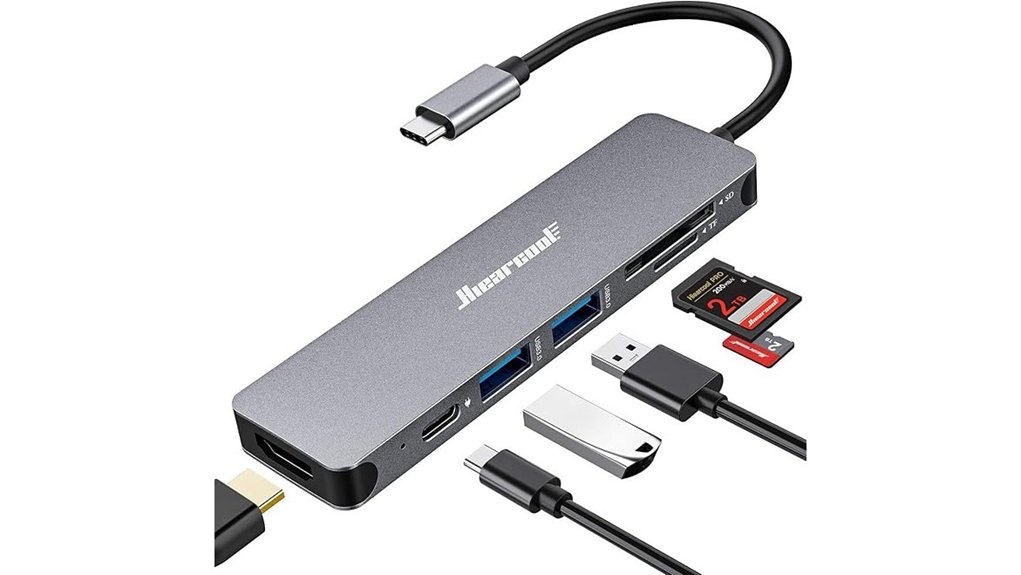
  • If SD/micro‑SD reading is essential, pick the Acer 7‑in‑1; for general card support, the SPDolby or Hiearcool hubs are suitable.
  • For dual‑monitor setups, the HP Universal USB‑C dock delivers 4K at 60 Hz, whereas most other hubs are limited to 30 Hz at 4K.
  • Opt for hubs that are driver‑free and cross‑platform (Windows, macOS, Linux, ChromeOS) to keep travel setup hassle‑free.

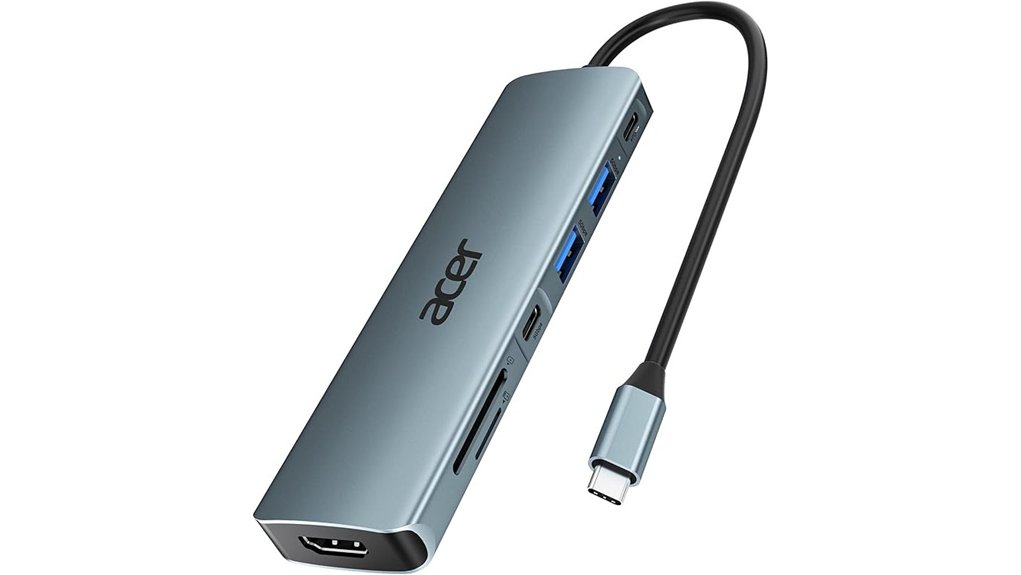
Acer 7-in-1 USB‑C Hub – 4K HDMI, 100W PD

100w 7 in 1 4k hub

If you need a single, compact adapter that lets you power a laptop, stream a 4K movie, and fill your ports, this Acer 7‑in‑1 USB‑C hub is the one for you. Aluminum construction keeps heat out while keeping the hub light at 2.11 oz and small at 5.12×1.38×0.39 in. Inside, you’ll find a 4K HDMI (30 Hz), two USB‑A 3.1 ports, a data‑only USB‑C, a 100W PD port, and micro‑SD plus SD slots. Use a 65W+ charger on the PD port for full performance. It works on MacBook, Windows, Linux, ChromeOS, and Samsung Galaxy tablets with DeX enabled and stay connected everywhere, simply.

Best For: mobile professionals and students who want a lightweight, all‑in‑one hub for 4K video output, fast charging, and multiple data connections.

Pros:

  • Durable aluminum chassis with excellent heat dissipation.
  • 100 W PD port supports rapid laptop charging (use a 65 W+ charger for optimal performance).
  • Includes 4K HDMI, dual USB‑A 3.1, and SD/micro‑SD slots for versatile connectivity.

Cons:

  • HDMI output limited to 30 Hz (no 4K @ 60 Hz or higher refresh rates).
  • USB‑C port is data‑only; cannot pass video or audio signals.
  • Requires a separate power supply – the hub does not power itself.

https://www.amazon.com/dp/B0CF224WX9

Acer 4‑Port USB 3.0 Hub with Type‑C Power

acer 4 port type c hub

The Acer UH501 turns a single USB‑C power port into four fast USB‑3.0 lanes, so you can plug in multiple external drives, keyboards, or network adapters at once. Because the hub draws power only from the USB‑C port, you don’t need an extra charger—everything stays tethered to your laptop’s single connection. Its GL3510 controller keeps heat low and lets all four ports operate simultaneously, delivering 5 Gbps data streams without bottlenecking. Compact at 4.13 × 1.18 × 0.35 in and weighing just 1.6 oz, the 2‑ft cable lets you move it from hotel desks to cafés without bulk. It runs on Windows, ChromeOS, Linux, and macOS daily.

Best For: People who need to connect multiple peripherals to a slim laptop or device that offers only a single USB‑C power port, such as MacBook or Windows users in travel or office settings.

Pros:

  • Expands one USB‑C power cable into four fast USB‑3.0 ports, providing plenty of connectivity without an extra charger.
  • Compact, lightweight design (4.13 × 1.18 × 0.35 in, 1.6 oz) and a 2‑ft cable make it highly portable.
  • Plug‑and‑play with no drivers required, works seamlessly on Windows, ChromeOS, Linux, and macOS.

Cons:

  • Power is drawn solely from the USB‑C port; the hub cannot charge high‑current devices that require additional power.
  • All four ports share the same 5 Gbps bandwidth, which can become a bottleneck if you use multiple high‑speed devices simultaneously.
  • The 2‑ft cable limits distance and can be a bit short for setups that require a longer reach.

https://www.amazon.com/dp/B0CN3F9Y1Z

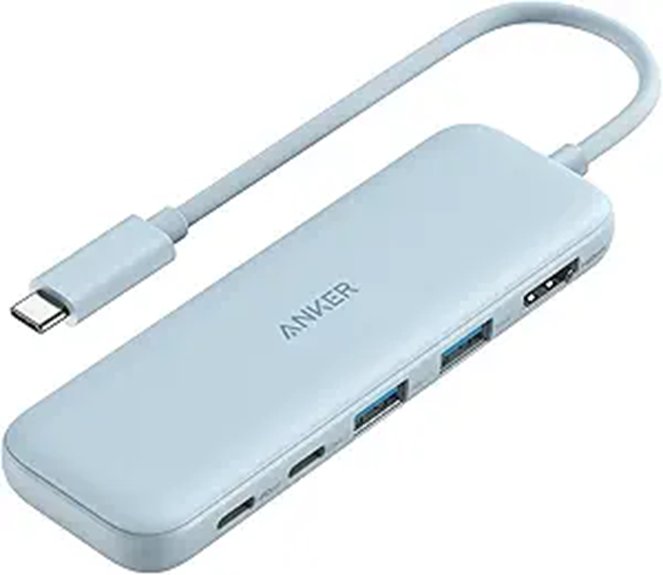
Anker 5-in-1 USB‑C Hub with 4K HDMI

anker 5 in 1 usb c hub

When you need a crisp 4K monitor on the go, the Anker 5‑in‑1 USB‑C hub delivers a 4K HDMI port that supports up to 4K at 30 Hz. Its slim, blue body weighs just 1.44 oz and measures 4.78 × 1.59 × 0.45 inches, making it a light‑touch extra in any bag. The hub gives you a 5 Gbps USB‑C data connection plus two USB‑A ports, plus a 100 W PD‑IN that can deliver up to 85 W to your laptop while you run the monitor. It plays nicely with Windows, macOS, and Linux‑compatible devices, so your MacBook Pro, Dell XPS, or Lenovo ThinkPad will stay powered and connected. In advance.

Best For: travelers who need a lightweight USB‑C hub that supports 4K video, fast file transfer, and laptop power delivery on the go.

Pros:

  • 4K HDMI output up to 30 Hz for crisp external displays
  • 5 Gbps USB‑C and two 5 Gbps USB‑A ports for high‑speed data transfer
  • 100 W PD‑IN with up to 85 W pass‑through charging keeps laptops powered

Cons:

  • HDMI maxes out at 30 Hz, not full 60 Hz 4K refresh
  • No Ethernet or card readers in the hub lineup
  • 85 W charging may not fully support the highest‑end 100 W laptop power needs

https://www.amazon.com/dp/B0CH9KN8TB

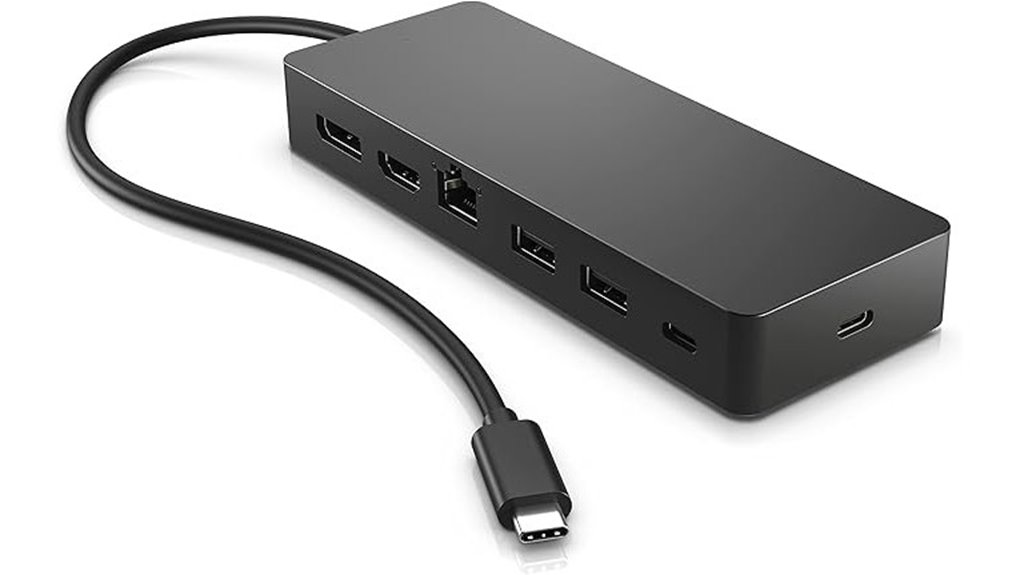
HP Universal USB-C Multiport Hub

hp usb c multiport hub

Powering your workstation on the go, the HP Universal USB‑C Multi‑port Hub delivers a 7‑port mix that supports dual 4K displays, Ethernet, and a pass‑through charging port.

You’ll connect two 4K monitors with the HDMI 2.0 and DisplayPort 1.2 ports, then toss your laptop into the 1 USB‑C pass‑through and keep it powered while data moves.

You’ll get a sleek, lightweight 4‑oz hub that measures 5.91 × 2.17 × 0.85 inches, fitting snugly in your bag.

It works on Chrome OS, Linux, Windows 10 and newer across all USB‑C laptops, so you don’t have to hunt for brand‑specific docks.

With two USB‑A ports, you can plug after‑sales accessories or a flash drive.

Everything’s packed in a chic black finish.

Best For: a mobile professional or student who needs a versatile, lightweight dock that supports dual 4K displays, Ethernet, and charging all in one compact hub.

Pros:

  • Ultra‑portable 4‑oz, 5.91 × 2.17 × 0.85‑inch design
  • Dual 4K video via HDMI 2.0 and DisplayPort 1.2
  • Cross‑platform compatibility with Chrome OS, Linux, Windows 10 + and any USB‑C laptop

Cons:

  • Only one USB‑C passthrough, limiting additional USB‑C peripherals
  • No SD card reader or built‑in audio jack
  • Single‑port USB‑C makes it less flexible for high‑bandwidth external devices.

https://www.amazon.com/dp/B0B25YNRC8

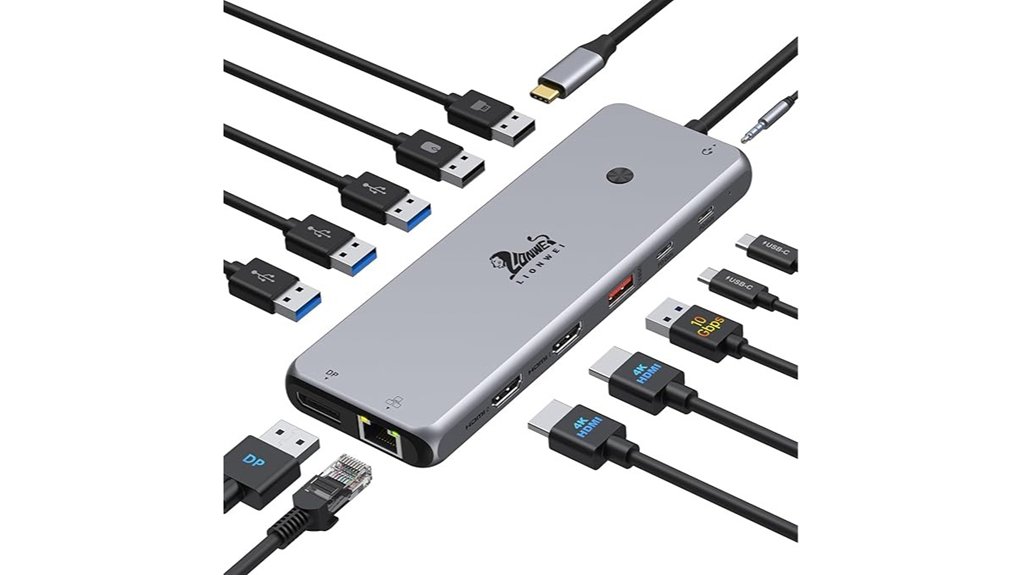
LIONWEI 13-in-1 USB-C Docking Station Dual Monitor

lionwei 13 in 1 dual monitor

Want a single, ultra‑portable hub that can fan out two 4K displays while still delivering up to 100 W to your laptop? You’ll connect it to any MacBook, Dell, HP, Lenovo, or Surface—just plug the slim 13×0.5×5‑inch device into your USB‑C port. It hands you two 4K HDMI ports and a DisplayPort, all running at 60 Hz, so you can mirror or extend across both screens on Windows, or extend a single 4K display on macOS. The two USB‑C daisy‑chains deliver 100 W PD and 10 Gbps data, keeping your laptop charged while you stream or game at full speed. 18‑month warranty included.

Best For: Professionals and power users looking for a slim, 13‑inch docking station that delivers dual 4K displays and 100 W of power delivery for laptops or Chromebooks on the go.

Pros:

  • Ultra‑compact footprint (13 × 0.5 × 5 inches) and lightweight (4.9 oz) for pocket‑ready portability.
  • Two 4K HDMI ports plus a DisplayPort, all running at 60 Hz, giving ample dual‑monitor support on Windows and a single 4K extension on macOS.
  • 100 W PD through dual USB‑C slots with only ~13 W draw, leaving ~87 W to charge the laptop while maintaining high‑speed 10 Gbps data.

Cons:

  • 4K@60 Hz is the maximum – no higher refresh rates or 8K output.
  • macOS supports only a single 4K monitor extension; no multi‑monitor support on Mac.
  • Limited USB‑3.1 Gen 2 count (one port) and no built‑in AV interfaces beyond the audio/mic combo.

https://www.amazon.com/dp/B0BNTHWWMY

UGREEN 4-Port USB 3.0 Slim Hub

ugreen slim 4 port usb3 0

Looking to double your laptop’s connectivity, the UGREEN 4‑Port USB 3.0 Slim Hub gives you four extra USB‑A ports from just one—perfect for busy professionals who need mice, keyboards, flash drives, and printers at arm’s reach. Plug it into any USB‑A socket, and you instantly get four high‑speed slots that keep up to 5 Gbps, meaning a 10‑GB transfer takes only about 16 seconds. It’s driver‑free, so Windows, macOS, Linux and even Chrome OS pick it up immediately. The hub’s minimalist 0.4‑inch thickness and 33‑gram weight make it pocket‑friendly for travel. UGREEN, a trusted brand, offers this black connector on a 0.79×7.48×4.33‑inch chassis.

Best For: busy professionals and travelers who need quick, driver‑free expansion of a single USB‑A port to four high‑speed slots for peripherals and storage.

Pros:

  • Adds four high‑speed USB‑A ports from just one existing port.
  • Ultra‑slim (0.4 inches thick) and lightweight (33 g) for effortless portability.
  • Plug‑and‑play with no driver installation needed on Windows, macOS, Linux, or Chrome OS.

Cons:

  • Limited to USB‑3.0; no USB‑C or faster interface options.
  • Shares power from the host port, which may affect performance with power‑hungry devices.
  • Lacks built‑in power supply, so it cannot charge devices while providing data connectivity.

https://www.amazon.com/dp/B0CD1BHXPZ

MOGOOD USB 3.0 Slim Laptop Hub (No Charge)

mogood slim usb 3 0

If you’re a mobile professional who needs a handful of extra data ports without the bulk of a charging hub, the MOGOOD 3.0 Slim Laptop Hub gives you exactly that—four USB ports (one high‑speed 3.0 and three 2.0) in a single, feather‑light package that slides right into any USB‑C laptop or tablet.

Plug straight in—no drivers—thanks to its OTG chip, mouse and keyboard. The 480 Mbps 3.0 port transfers files 10× faster; three 2.0 slots support printers and storage devices. Weighing 0.7 oz, it’s ideal for ultrabooks and travel. Certified for MacBook Pro 2019‑2021, Chromebook Pixelbook, and Samsung laptops, hub includes warranty.

Best For: mobile professionals and travelers who prioritize a lightweight, data‑only USB‑C hub for quick file transfers and peripheral connectivity without charging overhead.

Pros:

  • Ultra‑thin, lightweight design (0.7 oz) that fits perfectly in ultrabooks and travel bags.
  • Plug‑and‑play with no driver installation; the built‑in OTG chip supports hosting mice, keyboards, and other peripherals.
  • Combines one high‑speed USB 3.0 port with three USB 2.0 ports for versatile connectivity to printers, flash drives, and external storage.

Cons:

  • No power delivery or battery charging support, limiting use for device charging.
  • Only one USB 3.0 port; all other slots are slower USB 2.0, which may bottleneck performance when multiple high‑speed devices are attached.
  • Lacks advanced features such as powered hubs or multi‑port switching, making it less suitable for high‑performance workstation setups.

https://www.amazon.com/dp/B0BCHZG1PJ

USB 3.0 4-Port Hub Adapter

four port usb 3 0 adapter

The USB 3.0 4‑Port Hub Adapter plugs straight into any single USB slot, instantly expanding it into four independent ports that manage power and data efficiently—perfect for streamlining your workstation or gaming console with key peripherals like keyboards, mice, and USB flash drives while keeping your desk clutter‑free. You’ll appreciate its plug‑and‑play design—no drivers, no fuss. It stays cool even with multiple devices, but each port is limited to 900 mA, so larger drives may need external power. Expect up to 5 Gbps on USB 3.0 ports, and it works with Windows, macOS, Linux, Chrome OS, printers, game consoles, and OTG phones for efficiency.

Best For: laptop users, home office enthusiasts, and casual gamers who need quick expansion of USB 3.0 ports for keyboards, mice, flash drives, and other peripherals without any driver installation.

Pros:

  • Plug‑and‑play design—no drivers or software needed.
  • Compact, lightweight form factor (1.42 in × 0.43 in × 3.66 in, 1.59 oz).
  • Reliable USB 3.0 data transfer up to 5 Gbps and stable operation under multiple devices.

Cons:

  • Each port limited to 900 mA, so it cannot power large external hard drives or fast‑charging devices.
  • No built‑in external power supply; extra adapters needed for devices requiring more than 900 mA.
  • Not suitable for high‑current peripherals or heavy USB power usage.

https://www.amazon.com/dp/B0BWH9DZRV

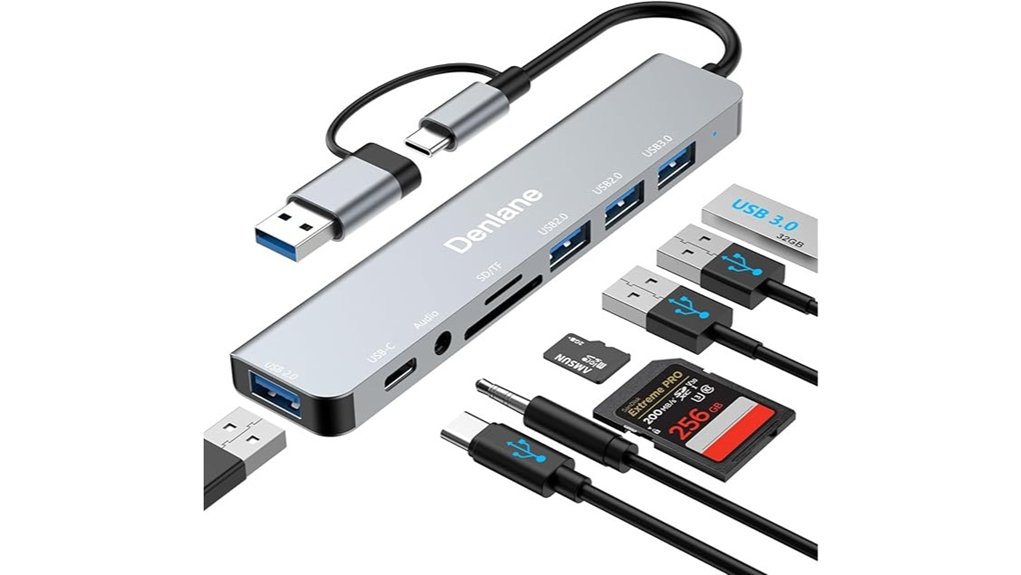
USB-C Hub 8-in-2 Card Slot Audio Adapter

usb c 8 in 2 audio hub

Need to keep your creative gear connected while on the go? This 8‑in‑2 USB‑C hub fits iPads, laptops, Android tablets, and even Xbox/PS4 consoles. It bundles one USB‑3.0 port for fast transfers, four USB‑2.0 ports for peripherals, a second USB‑C data slot, a TF/SD reader, and a 3.5 mm headphone jack— all in a 6.38 × 2.2 × 0.47 in aluminum shell that stays cool. Weighing just 2.08 oz, it’s travel‑ready and requires no drivers. The manufacturer backs it with a one‑year warranty and responsive support. Use it with any Type‑C device—Mac, Windows, Linux, Chrome OS, iOS, or Android—and run external drives or printers effortlessly; start today.

Best For: Creatives, students, and tech professionals who need a compact, driver‑free hub to connect multiple peripherals while traveling.

Pros:

  • Ultra‑compact, lightweight design fits in any bag.
  • Plug‑and‑play with no driver installation required.
  • Aluminum enclosure keeps components cool even under heavy use.

Cons:

  • USB‑2.0 ports offer limited bandwidth for high‑speed devices.
  • No power delivery; cannot charge devices.
  • One‑year warranty may be short for frequent travelers.

https://www.amazon.com/dp/B0F28PS8L2

4‑Port USB Hub & Lightning Cords for Phones

4 port usb lightning hub

Imagine a sleek 6.1‑inch hub that turns your laptop into a multi‑port powerhouse, letting you charge four phones while syncing data on the fly. The Best Buy Essentials kit packs Lightning, USB‑C, and USB‑A cords, plus a sturdy 4‑port USB hub and power adapters. It delivers consistent power and reliable data transfer, so you can backup files or play music on the go without a hitch. Built to withstand plugging, the hub offers several cable lengths and colors, cutting clutter and staying true to your work space or travel vibe. Weights 7.5 oz, measuring 6.1 × 3.07 × 0.98 in, it’s ready when you hit August 29 2025.

Best For: anyone who needs to charge multiple phones while syncing data in a tidy, travel‑friendly setup.

Pros:

  • Versatile cable set (Lightning, USB‑C, USB‑A) means no extra adapters needed.
  • Compact 6.1‑in hub delivers reliable power delivery and data transfer on all four ports.
  • Durable construction and several cable lengths/colors keep clutter under control and reach extended.

Cons:

  • No per‑port power‑output meters, so you can’t monitor charging status individually.
  • Limited to four ports—any additional devices require a separate hub or delay.
  • Lacks built‑in software for automatic data sync; files must be managed manually.

https://www.amazon.com/dp/B0FP6PD69H

Hiearcool 7-in-1 USB‑C Hub 4K HDMI 100W PD

100w 7 in 1 4k hub

If you’re a professional juggling laptop workloads, presentations, and media files, the Hiearcool 7‑in‑1 USB‑C Hub packs everything you need into one lightweight unit. It expands your laptop into a full‑featured station, so you can run 4K HDMI displays, charge the machine, and switch between tasks without missing a beat. Your 4K@30 Hz HDMI port delivers crisp visuals on projectors or TVs, ideal for sales decks or binge‑watching after hours. The 100 W Power Delivery pass‑through keeps you connected and charged, eliminating the need for a separate charger during long calls. Port selection has two USB 3.0 slots and an SD reader.

Best For: professionals who need a compact, 4K‑ready USB‑C hub for meeting‑room setups, video presentations, and on‑the‑go multitasking while keeping their laptop powered up.

Pros:

  • 4K @30 Hz HDMI output for clear displays on projectors or TVs.
  • 100 W USB‑C Power Delivery pass‑through keeps laptops charged during long sessions.
  • Light, aluminum design (1.8 oz) that fits easily into travel bags or desk trays.

Cons:

  • HDMI refresh rate limited to 30 Hz, not suitable for high‑frame‑rate gaming or video editing.
  • No Ethernet or 3.5‑mm audio jack, limiting connectivity options.
  • Only two USB 3.0 ports, which may not be enough for users with many peripherals.

https://www.amazon.com/dp/B07WPTG7NX

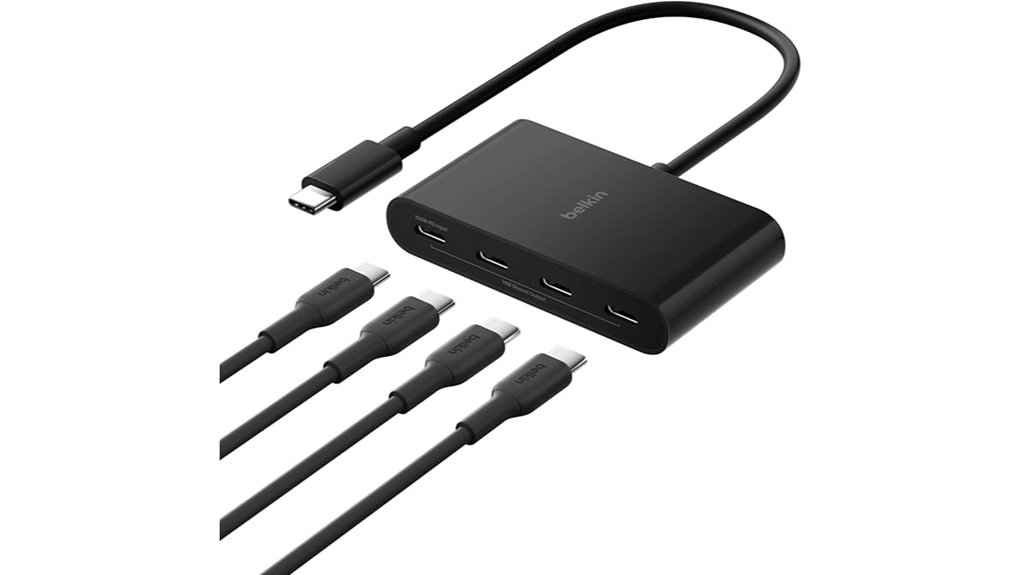
Belkin Connect 4-USB-C Hub with 100W PD

belkin 4 port usb c pd

Because you demand an uninterrupted workflow, the Belkin Connect 4‑USB‑C Hub supplies up to 100 W of pass‑through power while giving you four high‑speed 10 Gbps USB‑C ports—all in a single, compact device. Every USB‑C port runs at 3.2 Gen 2, delivering 10 Gbps. You’ll notice tremors vanish when you swap devices thanks to Fast Role Swap. The hub handles audio, a webcam, video capture card, and external SSDs seamlessly. Compatibility extends to MacBooks, iPads, PCs, and Chromebooks, with backward support for older USB‑C gear. Its lightweight form—1.6×3.0×0.6 in—fits in your bag, and a two‑year warranty covers you throughout your travels with uninterrupted power.

Best For: creative professionals, gamers, and mobile users who need fast data transfer, robust 100 W charging, and a compact, versatile hub for travel and work.

Pros:

  • 10 Gbps data transfer on four USB‑C 3.2 Gen 2 ports
  • 100 W pass‑through power with 85 W to host plus Fast Role Swap for seamless device switching
  • Compact, lightweight design (1.6×3.0×0.6 in, 1.76 oz), recycled materials, and a 2‑year limited warranty

Cons:

  • No HDMI or DisplayPort output for video expansion
  • Requires a compatible high‑power USB‑C charger to reach full 100 W
  • Slightly pricier than single‑port USB‑C hubs, limiting budget‑friendly options

https://www.amazon.com/dp/B0BY27XSJ3

Portable 8-in-1 USB-C Laptop Docking Hub

portable 8 in 1 usb c hub

Professional travelers and remote workers will appreciate how this 8‑in‑1 USB‑C docking hub turns one port into an entire workstation.

You connect a 4K HDMI screen at 30 Hz, two USB 3.0 ports, a USB‑C port, and a SD/TF reader—all from a single plug.

It powers your laptop to 85 W, and you’ll keep peripherals active.

The stand offers six height levels and anti‑slip silicone pads that keep heat out.

Weighing just 0.9 lb with a 10.5 × 2.2 × 0.9‑in travel pouch, it expands to 11.5 × 2.5 × 1.4 in when unfolded.

Suitable for MacBook, Dell, HP, Lenovo, and ASUS models, this Umaniy M57 is ready to travel from Oct 21 2024.

Best For: remote professionals, frequent travelers, and hybrid workers looking to convert a single USB‑C port into a full desktop experience with display, data, power, and a collapsible stand.

Pros:

  • 4K HDMI (30 Hz) plus dual USB 3.0 and USB‑C data ports, all packed into one slim connector.
  • Built‑in 85 W PD 3.0 charging keeps laptops powered while peripherals are active.
  • Six‑level foldable stand with anti‑slip pads and airflow design—lightweight, 0.9 lb, fits in a travel pouch.

Cons:

  • 4K output limited to 30 Hz, may not satisfy high‑refresh‑rate gaming or video editing.
  • Lacks Ethernet, audio output, or SD‑card write support, requiring additional dongles.
  • Premium price point compared to basic hubs, may be overkill for casual users.

https://www.amazon.com/dp/B0DKFG5X46

Dell Pro 4-in-1 USB‑C Travel Hub DA225 Black

dell pro 4 in 1 hub

The Dell Pro 4‑in‑1 USB‑C Travel Hub DA225 Black is made for travelers who need reliable power and connectivity on the go. You’ll love its slim chassis and 10.63‑inch cable—it slips effortlessly into your laptop sleeve or backpack. It bundles two USB‑C PD ports, a standard USB‑A, and a 4K‑60Hz HDMI jack, letting you charge, produce, and share all at once. Embedded power‑balancing tech continually tunes output to match each device’s needs, so you avoid over‑consumption and keep battery life intact. Notifications keep you updated on port status and power usage while you’re on the move during flights today.

Best For: frequent travelers, students, or business professionals who need a compact, cable‑ready hub that delivers power, data, and high‑resolution video without bulk.

Pros:

  • Sleek, portable chassis with a 10.63‑in cable that slides easily into a laptop sleeve or backpack.
  • Dual USB‑C PD ports and a standard USB‑A port provide versatile charging and data connections.
  • Embedded power‑balancing technology automatically optimizes output, preventing over‑consumption and preserving battery life.

Cons:

  • Only two USB‑C ports may limit simultaneous device connections for power-hungry setups.
  • The HDMI output is 4K @ 60 Hz, which requires compatible displays and may not be usable on older monitors.
  • No active cooling or fan; heavy, continuous use could raise device temperature.

https://www.amazon.com/dp/B0FQXHW8BV

Anker 14-in-1 USB‑C Docking Station

anker 14 in 1 usb c dock

Want a compact node that lets you power your laptop and connect three high‑resolution displays at once?

Anker’s 14‑in‑1 hub makes your USB‑C port a workstation.

It streams two 4K HDMI and a 1080p VGA, letting you run three monitors.

80 W PD keeps your laptop charged multitasking.

The dock delivers 5 Gbps USB‑C data, five USB‑A 5 Gbps ports, 1 Gbps Ethernet, SD/microSD slots, and a headphone jack for multitasking.

Measuring 5.91×2.13×0.67 in and 4.7 oz, it slides into any bag.

Works on macOS 12+, Windows 10/11, ChromeOS—Linux unsupported.

Anker backs it with an 18‑month warranty and support.

Best For: professionals who need a compact, power‑connected dock to drive three high‑resolution displays from a single USB‑C port.

Pros:

  • Dual 4K HDMI output (60 Hz) plus a 1080p VGA port for multi‑monitor setups.
  • 80 W power delivery pass‑through keeps laptops charged while multitasking.
  • Lightweight (4.7 oz.), ultra‑compact form factor with 5 Gbps USB data and Ethernet connectivity.

Cons:

  • No support for Linux systems; compatible only with macOS 12+, Windows 10/11, and ChromeOS.
  • macOS limits VGA output to a mirrored display only.
  • Requires DP Alt Mode and Power Delivery on the USB‑C port; may not work with all USB‑C laptops.

https://www.amazon.com/dp/B0CF52HF6D

Factors to Consider When Choosing Universal USB Hubs for Travel Laptops

Start by verifying the hub’s port compatibility range so it covers both USB‑C and any legacy USB ports you’ll need.

Next, check the power‑delivery rating, build durability, and size‑weight limits, because a lightweight yet solid hub with strong PD is essential for travel.

Finally, guarantee the data‑transfer speeds meet your workflow, aiming for USB 3.0/3.1 Gen 2 or higher.

Port Compatibility Range

Many travel‑ready creators need a hub that won’t let you fall short when you switch from a cloud drive to an external monitor. Make sure the hub includes at least one HDMI port that pushes 4K at 30 Hz or 1080p, matching the laptop’s dock‑capable display output. Check that it offers both USB‑A 3.1 (5 Gbps) and USB‑C 3.2 Gen 2 (10 Gbps) ports, giving you flexibility whether the laptop uses alternate‑mode video or needs high‑throughput storage. Dual microSD and SD card readers—each supporting UHS‑I up to 104 MB/s—serve photographers, editors, and field reporters who swap cards on the fly. Finally, the hub should include a Gigabit Ethernet RJ‑45 port with at least 100 Mbps throughput, so you retain a wired connection whenever Wi‑Fi falters, every trip, and stay productive.

Power Delivery Capability

Alongside those port features, if you’re carrying a laptop that demands consistent power, you’ve got to look at the hub’s power‑delivery capability. You’ll need a hub that supports up to 100 W USB‑C PD. That lets laptops stay charged while you plug in drives, monitors, or a VR headset. Pair the hub with a 65 W or higher charger; a lower‑wattage adapter throttles the laptop’s charging speed or disables boost modes. USB‑PD 3.1 negotiates 5 V/3 A, 9 V/3 A, 15 V/3 A, or 20 V/5 A outputs so your device gets the right voltage. A typical 100 W hub draws about 15 W for itself, leaving roughly 85 W for the laptop—enough for most ultrabooks and rigs. If the hub advertises Gen 2 data, it uses TP4 10 Gbps link, so SSDs remain active while your machine charges.

Build Durability Assessment

When you’re packing for long trips, the build quality of a universal USB hub becomes as important as its port count. Choose a hub with a thin aluminum chassis—roughly 0.39 in by 5.12 in by 1.38 in—because it dissipates heat while weighing about 2 oz. Die‑cast metal housings add impact resistance, keeping the hub sturdy when you bump it in a backpack. Look for an integrated LED that’s shaded by a polycarbonate cover; that keeps the indicator bright even after thousands of plug‑in cycles. The cable length, about 1.5 ft, flexes without stressing connectors, extending its lifespan. Finally, verify DIN‑rated connectors and reinforced solder joints that meet IEC 60068 thermal‑shock tests, guaranteeing consistent performance through temperature swings. Stick with vendors that certify these specs on their page for peace of mind.

Size And Weight Limits

Because a hub that fits snugly in your laptop sleeve saves space and reduces bulk, you’ll want one that’s under six inches long, one to two inches wide, and only 0.3 to 0.5 inches tall. If it weighs 4 to 6 ounces, you add no noticeable heft to your bag. Keep every side under five inches, and limit the chassis to less than a quarter square foot, roughly ten square inches. Weighing just 110 to 170 grams, the hub stays lightweight enough to travel with you without weighing down your packs. A 0.8‑to‑1.2‑inch thick design lets you tuck it beside your notebook, keeping your carry‑on comfortable. Remember, a slim profile avoids snagging on straps or in arm‑hole pockets, making travel smoother. Every trip smoother.

Data Transfer Speeds

The speed of your data transfer hinges on the hub’s USB version and its internal routing architecture. If you rely on USB 3.0 ports, expect up to 5 Gbps, which is perfect for SSDs and large video files. USB 2.0 sticks at 480 Mbps and can choke high‑resolution media, especially if you plug in multiple devices. Dual‑chip hubs let every USB 3.0 port keep full 5 Gbps, sidestepping a single‑bottleneck issue. For the fastest backups, look for USB 3.1 Gen 2 ports that double the pace to 10 Gbps, ideal for 4K footage. Beware hubs that funnel all traffic through one controller—shared bandwidth can throttle each port when you’re busy. Use USB 3.0/3.1 cables, provide power, and keep firmware updated to avoid bandwidth sharing among heavy devices, and quickly maximize throughput efficiency today.

Pricing And Value Ratio

Choosing a hub starts with weighing the price against the features that matter for your trip. You’ll find 4‑port USB‑C hubs with 100 W pass‑through priced $30–$80, while models that handle dual 4K displays leap above $150, so match power and display needs to your budget first. Higher prices usually mean a heavier, aluminum chassis with heat‑dissipation; heavier hubs weigh more but stay durable. Below $40 hubs stay lightweight and plastic. Warranty length hints at build quality: 12‑month warranties usually cost less; 24‑month no‑warranty models climb to the upper range. A mid‑tier $60–$90 hub bundles four USB‑A, one USB‑C, and one HDMI, striking a strong cost‑benefit. Evaluate price per functional port: an $80 hub with five outputs averages $16 each, beating a $40 hub with two ports today.

Brand Warranty Coverage

If you’re heading out on the road, a solid warranty can protect your hub investment. Most USB hub warranties run 18–24 months, covering manufacturing defects when you use the device normally. They’ll replace parts and cover labor, but exclude misuse, drops, or liquid damage. To qualify, keep the hub in its original, unopened box; if you open it before returns, you may hit a restocking fee, especially after 30 days. Some brands give a “no‑question” exchange, while others demand proof of purchase and shipping the unit to a service center. You can buy extended or accidental‑damage coverage, but that’s separate from the standard limited warranty. A longer warranty gives you peace of mind, especially when you’re traveling with a schedule and limited service options.

Frequently Asked Questions

Is the Hub Compatible With macOS Sierra 10.12?

Yes, it works with macOS Sierra 10.12. The hub’s drivers are built for 10.12 and earlier, so you’re good to go without extra software. Just plug it into a USB‑C port, and macOS will automatically recognize it, providing multiple ports for your peripherals. If you hit any hiccups, try a recent firmware update or a simple restart, and everything should sync smoothly. You’ll find support documentation online if needed today.

Can I Feed the Hub’s Usb‑C Power Delivery From a Phone Charger?

Yes, you can power the hub with a phone charger, as long as the charger supplies 5 V or 9 V at 2 A or higher, matching the hub’s USB‑C PD requirements. Don’t use a low‑output charger; the hub needs at least 10 W. Also, watch for the cable’s quality—use an official USB‑C cable that supports PD, and you’ll keep everything powered safely. If you forget, you’ll see power notifications and warnings.

Will the Hub Survive Luggage Compression During Travel?

Sure, it’ll survive luggage compression—you’ll hardly notice a bump. The hub’s compact, rugged design resists jostling, and its reinforced ports handle torque. Airports ask for durable gear, so lighten your worries. Just pack it in a padded laptop sleeve, or strap it to a non‑compressed area. Then you’ll have all ports at hand, free of surprises, ready for work or play with confidence for peace of mind and all devices.

Are There Any Thermal Throttling Concerns During Extended Use?

Yes, you might worry about thermal throttling when you use a hub for long periods. Most cheap options run a single CPU‑level controller that can overheat, causing your laptop to slow itself down. But reputable models spread heat across multiple chips and include tiny fans, so you’ll rarely see throttling unless you plug in dozens of high‑draw devices at once. Keep the hub balanced, and you’ll stay cool for sure.

Does the Hub Support USB4 or Thunderbolt 4 Port Standards?

Yes, the hub supports both USB‑4 and Thunderbolt 4, but you’ll notice its performance hinges on how the ports are wired. Plugging a Thunderbolt 4 device gives you full 40‑Gbps bandwidth, lightning‑fast data and power. USB‑4 devices, meanwhile, share a single lane, so speeds drop to 20 Gbps. Still, the hub’s controller keeps temperature in check, so you won’t see thermal throttling during long sessions. Experience unmatched speed activating all ports right today.

Conclusion

Picture your laptop as a lone traveler, its journey a long road through digital landscapes. That hub on your bag is the trusty compass, pointing north to every port. It’s the navigator of your digital voyage, steering you clear of dead ends. When cities shift and screens flicker, the hub never falters, just as a seasoned navigator trusts their compass. Keep it close and let it guide your tech adventure on every digital horizon today.